On a scale of 1 to 10… June 20, 2016
Posted by stinawp in Uncategorized.add a comment
My opinion of 1 to 10 ratings scales is extremely low, since I can very rarely figure out what the ends actually represent. With something like “Please rate your pain on a scale of 1 to 10”, shouldn’t the pain at 10, by definition, be nearly unimaginable? Even if they say that a broken bone is x, that doesn’t help much if you’ve never had one.
So I was rather surprised to realize that I could conceive of a 1 to 10 rating scale for mosquito intensity or density. On the low end, there are zero mosquitos. On the high end, there are so many mosquitos that you suffocate, either because they physically block your airways or the swelling from internal mosquito bites blocks them. I suspect that level of intensity is biologically impossible, but it is imaginable. After a little more thought, I also realized that I think this scale is logarithmic, with 1 corresponding to 10 or fewer mosquitos in the vicinity, 2 corresponding to 10 to 100 mosquitos, etc.
I’d say we’re currently between 1.5 and 2 on the mosquito scale. I suspect the high 2s or low 3s is when a face net becomes an absolute necessity. If nothing else, saying the mosquitos are only a 2 on a scale of 1 to 10 does make them seem more tolerable.
So, on a scale of 1 to 10, how much sense does that make?
Chrysalis June 16, 2016
Posted by stinawp in Uncategorized.add a comment
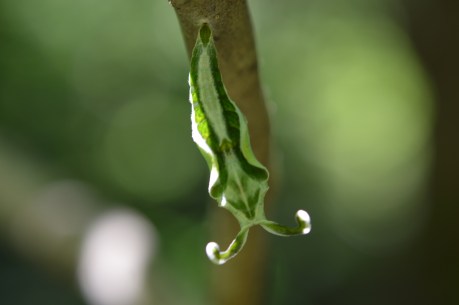
One of my caterpillar host plants had a very striking chrysalis hanging on it for about a week and a half. On June 6, it looked like this:
and from the side, it looked an awful lot like a slightly wilted leaf
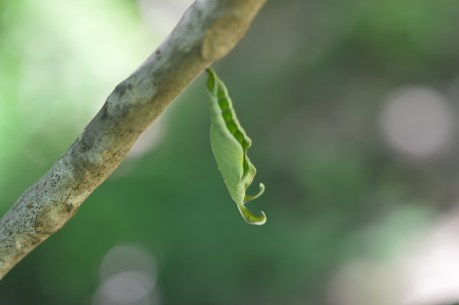
By the 14th, the colors had changed and it was pretty obvious that it was some sort of swallowtail butterfly:

On the 15th, it was gone. I assume it had emerged and was flying around.
A jeep and trilingual confusion June 13, 2016
Posted by stinawp in Uncategorized.add a comment
June 7, 2016
This morning, I came across a truly impressive jeep. While a lot of the rental companies have little 4WD mini-jeeps (jeeplets?) that they rent out to tourists, this was a substantial Range Rover with enough extra gear tied onto it to make it about twice as big as a jeeplet . The jeep and everything on it looked like it had seen a few miles.
This turned out to be a major understatement. When I stopped to talk to the couple packing up the car, they said that they’d started in southern Argentina, driven up through most of South America (they skipped Venezuela), and were about halfway through their four-week stay in Costa Rica. They didn’t say when they began, but given that they were spending about a month in each country, I suspect they started around the beginning of 2016. After they leave Costa Rica, they’re planning on driving all the way through to Mexico. Then they’ll go back home for the winter and pick up driving again in the spring. Their ultimate goal? Alaska.
Since ‘home’ for them is Germany, I got a chance to practice my German, at least for a little bit. I accidentally dropped enough Spanish words into the German that they decided that it would be easier to just speak English. Although my Span-deutsch was definitely messy, I think it’s a mess in the right direction. Before this, when I was accidentally dropping words in the wrong language into German, they were in English. Here’s hoping that this means the Spanish is starting to settle into my brain.
Wildlife Xing June 9, 2016
Posted by stinawp in Uncategorized.add a comment
Someone quite artistic has replaced the generic ‘Caution: animals — 35 KPH’ signs with individually hand-painted ones:

A very accurate pair of curassows, which frequently cross the road, although not exclusively at this spot.
Unfortunately, I saw most of these as I was getting into the station by taxi, so I was unable to get a close look at the whole set. The other one close to the station is this one:
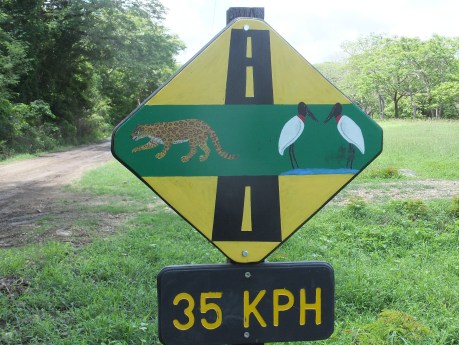
That’s a jaguar and a pair of jabirus, which are huge storks.
I have to say that I’ve never seen either of those cross the road, there or anywhere else. But I did see a jabiru fly by a few days ago. And a couple of days ago, I saw these farther down the road:
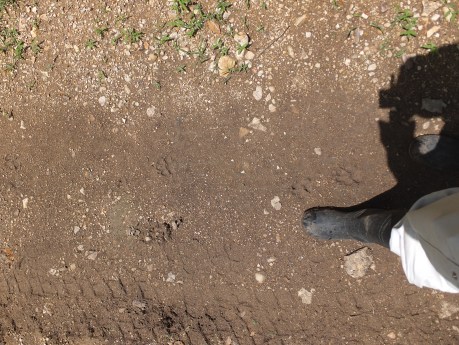
It was probably a puma, though. Jaguars are on the park species list, but they’re very rare.
Mud, glorious mud! June 6, 2016
Posted by stinawp in Uncategorized.add a comment
June 2, 2016
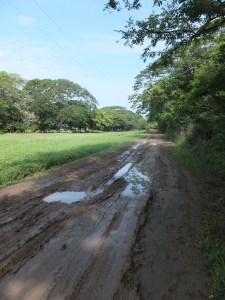
Well, I made it, and it rained a respectable amount here in May. So we’ve got mud:
We’ve got mosquitos (photo not included), and we’ve got water in the wetlands:
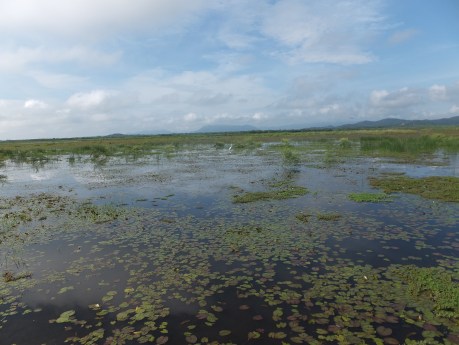
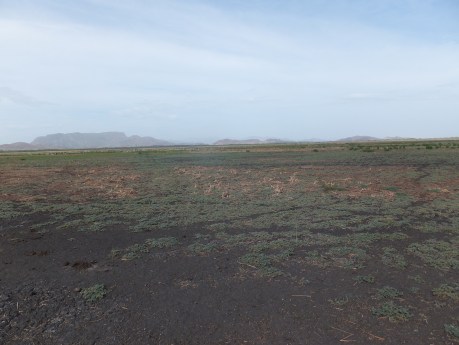
The water’s not quite as high as I remember it being back in 2013, but it’s quite an improvement over last year. In case you don’t remember, when I arrived in 2015, the “wetland” looked like this:
loose ends of from the close of a chapter in life September 20, 2015
Posted by newsthatstaysnews in Uncategorized.add a comment
– why do leonardo and michelangelo get a chance to design fortifications?
because gunpowder was new and charles viii had just shown up in italy to trash everything
– “A vast man, olive-colored like his coat on old, old roller skates, gently shifting his weight as he rolled down the hill”
– commemorative wedding frisbees
– because sometimes one needs a fantasy novel (as yet unread): http://www.amazon.com/The-Name-Wind-Kingkiller-Chronicle/dp/0756404746
– fast unfolding of communities in large networks: http://arxiv.org/abs/0803.0476
– gary klein, on when we’d trust AI:
Accuracy and reliability are important features of collaborators, but trust goes deeper. We trust people if we believe they are benevolent and want us to succeed. We trust them if we understand how they think so that we have common ground to resolve ambiguities. We trust them if they have the integrity to admit mistakes and accept blame. We trust them if we have shared values—not the sterile exercise of listing value priorities but dynamic testing of values to see if we make the same kinds of tradeoffs when different values conflict with each other. For AI to become a collaborator, it will have to consistently try to be seen as trustworthy. It will have to judge what kinds of actions will make it appear trustworthy in the eyes of a human partner.
– irene pepperberg on experiment design:
I am reminded of one of the earliest studies to train apes to use “language”—in this case, to manipulate plastic chips to answer a number of questions. The system was replicated with college students, who did exceptionally well—not surprisingly—but when asked about what they had been trained to do, claimed that they had solved some interesting puzzles, and that they had no idea that they were being taught a language. Much debate ensued, and much was learned—and put into practice—in subsequent studies so that several nonhuman subjects did eventually understand the referential meaning of the various symbols that they were taught to use, and we did learn a lot about ape intelligence from the original methodology. The point, however, is that what initially looked like a complicated linguistic system needed a lot more work before it became more than a series of (relatively) simple paired associations.
– peasants have historically always lost their uprisings, with brief exceptions in the last few centuries because guns were a great equalizer
– “if you have no more to tell us than that one barbarian succeeded another on the banks of the oxus or ixartes, what use are you to the public?” (voltaire)
– Awaking in New York, by Maya Angelou
– the movie Zatoichi, the blind swordsman (as yet unwatched)
– the movie Robot & Frank
– the end of history illusion
Daniel Gilbert’s name for the fact that people always predict less personal change for the future than they either report for the past, or than they will report for the interval once it’s done
– the original steele & sussman lambda papers: http://library.readscheme.org/page1.html
– Mary Catherine Bateson, on a future with AI:
Will we be better or worse off if wishful thinking is eliminated, and perhaps along with it hope?
– a poem by e.e. cummings
wee
MaddAddamites and other futures July 26, 2015
Posted by stinawp in Uncategorized.add a comment
As usual, I’ve been listening to audiobooks while photographing caterpillars and doing other repetitive tasks in the lab. Some of the first books I listened to this summer was Margaret Atwood’s MaddAddam Trilogy. They’re really good, although some of the characters have a questionable grasp of some aspects of biology. When that happens in fiction, I’m never quite sure whether it reflects on the character or on the author. Regardless, the trilogy is a very interesting vision of a post-climate-change, post-apocalyptic world.
That was the only problem with listening to those books here and now. When everyone’s saying next year will either be a normal year or even drier than this one, the last thing you want to be asking is “what if there are no more normal years?” So since then I’ve stuck to space-based science fiction or classic literature. I’m currently listening to War and Peace, because marching through the Russian winter with Napoleon is about as far away from dried-out Palo Verde as I can get.
The little things July 26, 2015
Posted by stinawp in Uncategorized.add a comment
June 26, 2015
I ran into the naturalist/graduate student giving a couple a tour this morning. This isn’t unusual, since the easiest way to see lots of different (vertebrate) animals is to go west along the road, and the easiest way to find lots of caterpillars is to go west along the road. Tours often give me a chance to see animals I wouldn’t otherwise notice or see well, since I don’t carry binoculars. In this case, it was a crane hawk perched far back in a tree. It looked like a typical dark-colored hawk except for its long bright red legs so I made the appropriate noises and went on working.
After I finished looking for caterpillars, I rode back to the station with them. On the way back, I spotted a male long-tailed manakin. It was mostly black too, but with a red cap, a bright blue upper back, and two really long tail feathers. Unfortunately, the couple was on the wrong side of the car, so neither one of them got to see it. We tried to get out and find the manakin, but it flew into the forest.
It’s a sad truth that most of the animals here will see, hear, or smell you and take evasive action long before you spot them. Insects are the exception. Here’s the one non-caterpillar I was able to take a picture of today:
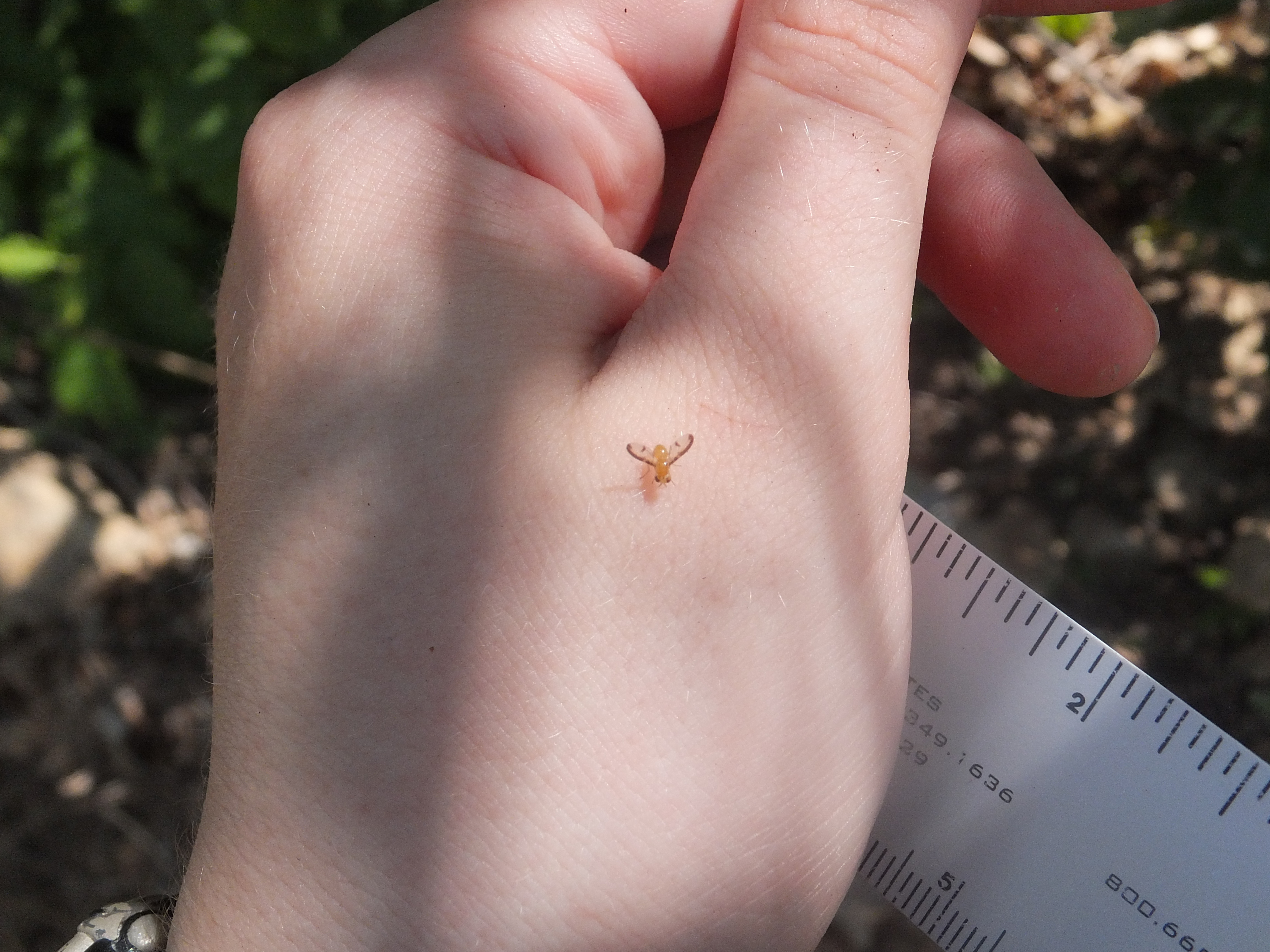
A fly (Diptera). To tell you more, I’d have to look at the wing veins and see how many bristles it has on its shoulders.
Frustrations and apologies July 21, 2015
Posted by stinawp in Uncategorized.add a comment
July 21, 2015
If anyone is still reading despite my erratic postings or lack thereof, my thanks and apologies. My excuse isn’t that I’m totally lacking in self-discipline, but that the vast majority of it is currently keeping me plodding along on a very frustrating project. One part of my research—the part where I’m trying to measure the effects of many different caterpillar shelters on caterpillar survival—is going as well as can be expected given the lack of rain. The problem is another project—to switch caterpillars from two different species into each other’s shelters and see how much differences in survival are just caused by the shelter itself.
Unfortunately, both the plants the caterpillars eat and the butterfly adults are particularly vulnerable to dry conditions. When the host plants first sprouted in early June, I watered patches of them daily so they’d look appealing to the females laying their eggs. Then some big herbivores (maybe deer, maybe iguanas) started eating the plants in one bite. A couple weeks ago, the adults finally appeared and started laying eggs on the plants. But when the caterpillars hatched, they built shelters that were very different from the ones I expected them to build. I spent a few days trying to figure out whether I could still do the experiment if they were building several different types of shelters instead of the one type I’d expected. I decided to give it a shot and switched a few pairs of caterpillars.
That was when the herbivores came back and ate a bunch of my plants, caterpillars and all.
***
Normal posts will continue soon. I promise to put at least two more up by the end of this week.
Drawing a line July 16, 2015
Posted by stinawp in Uncategorized.add a comment
June 20, 2015
Today we had mondogo (tripe) soup for lunch. It was well-prepared, tender, and quite unobjectionable. However, there were also some large gobbets of clear gel. It tasted like a combination of unflavored gelatin and a chunk of pure fat, like on the edge of a pork chop. I decided that one bite of this new mystery food was quite enough. So what was it?
After a while, I put together the faint burned smell in the air and bones in some of the other soup bowls and came up with bone marrow. I remember the odor from a time when I helped roast marrow bones, essentially on a dare. I don’t know how bones can still smell burned when they’ve presumably been boiled, but the smell’s memorable and, for me, off-putting. I didn’t try any of the marrow after I helped cook it, and I would have been perfectly happy continuing that.
On the other hand, I can this to the list of organs I’ve eaten the next time I teach a pig dissection in lab. I find it a little disturbing how much credibility telling my students I’ve eaten tripe gets me.
Postscript: A week or so later, I was forced to acknowledge that I’ve occasionally been eating liver here for the last three years. At first, I thought the difference in flavor and texture was a result of marinating beef. Then I realized that the cooks serve some pretty tough cuts of meat without the benefit of marination and decided not to think about it further. This blew up when one of the student researchers here had some on her plate, was told in Spanish what it was, looked disgusted, and put it back in the pan. I didn’t catch the Spanish, but I had a pretty good guess as to what it was. I guess all those pig dissections were good for something after all.
 News That Stays News