Laugh, guaco, laugh June 4, 2017
Posted by stinawp in Uncategorized.add a comment
June 3, 2017
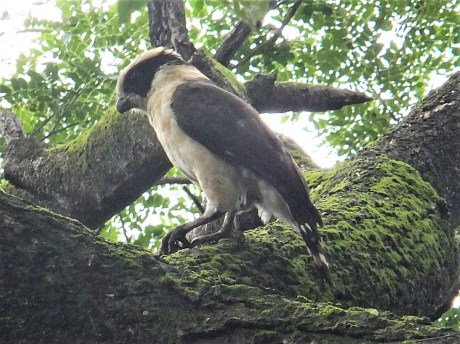
Its name doesn’t have the right number of syllables to fit into the kookaburra song, but Costa Rica has its own laughing bird: the laughing falcon (Herpetotheres cachinnans). Even if you’re as bad at imitating bird calls as I am, the guaco is safe to mimic, because it produces everything from a quiet chuckle to evil-genius maniacal laughter, with the gwa-co call that gives it its Spanish name somewhere in the middle.
A husband and wife who were here earlier in the week said they were really hoping to find a guaco, because it was “her” bird: she’s Japanese and the first to syllables of her name are gwa-co, although I presume it’s spelled differently. Unfortunately, they were always in the wrong place at the wrong time to find one, even though we’d heard one several times in the mornings.
This morning, we actually saw one, and because it was so overcast, I was able to take some halfway decent photos, although I still needed to adjust the lighting quite a bit. Allow me to present… the guaco!
“Didn’t you finish your field work last year?” June 1, 2017
Posted by stinawp in Uncategorized.add a comment
Let’s face it, I’ve probably already had conversations with all of you about what I’m doing in Costa Rica this summer, but on the off-chance you’ve forgotten, or someone I don’t know is actually reading this, I’ll recap. I did finish my dissertation field work last year, and there was much rejoicing. After that, I applied for a Doctoral Dissertation Improvement Grant from the National Science Foundation, which provides money for what I’ve been calling a “cherry on top” project: It should make your dissertation even better, but it’s not part of your dissertation. In February, I found out that I was receiving the grant, and there was rejoicing, although it didn’t start immediately. (I had to send a couple of confused emails to my advisor because the bureaucratese was so dense, I couldn’t tell whether I was getting the grant or not.)
So, what am I doing with your taxpayer dollars? I’ve got two experiments going: a low-tech one and a high-tech one. The low-tech experiment involves putting hundreds of shelter-building caterpillars out in the field in different types of groups to see what the pros and cons of sharing a shelter with other caterpillars are. Are they better protected? Do they benefit from sharing the construction costs, or does the competition with their housemates hurt them? Right now, we’re* rearing bags and bags of tiny caterpillars in the lab until they’re big enough to put out on plants, which we’re doing every day now. Even though this is the labor-intensive, it’s still less work than what I was doing last year, which should give me time to work on my dissertation.
The high-tech experiment is pretty neat: we’re installing temperature and humidity sensors in shelters and on nearby leaves to see whether the shelters are providing any climate control for the caterpillars, and whether that has an effect on caterpillar survival. This is something people have been asking me about for years, but I never had the equipment to answer the question.
When a tree is all wired up, it looks like this:
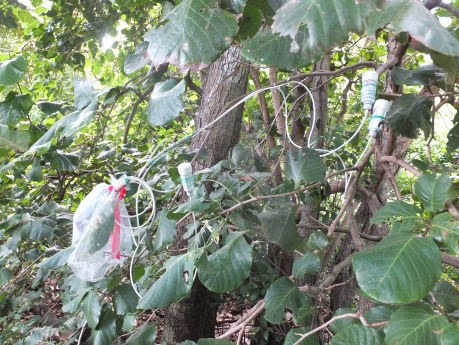
Each of the white tubes is a data logger that records the temperature and humidity every 15 minutes from a sensor. The bags around the leaves keep the caterpillars from being killed by anything except the environment. We check on the caterpillars each day, then move the equipment to a new shelter after three days.
Why does this matter? Well, since some shelter-building caterpillars can damage forests or crops and others are threatened, understanding shelters will make managing those species easier. And understanding how much shelters protect caterpillars from the environment is important for predicting how vulnerable these caterpillars are to global warming. If you want more details check out the project abstract at the NSF website: https://www.nsf.gov/awardsearch/showAward?AWD_ID=1701855&HistoricalAwards=false
* Yes, I have help. More about that later.
Happy belated Biodiversity Day! May 28, 2017
Posted by stinawp in Uncategorized.add a comment
May 28, 2017
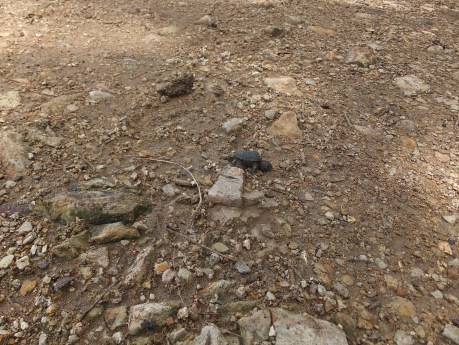
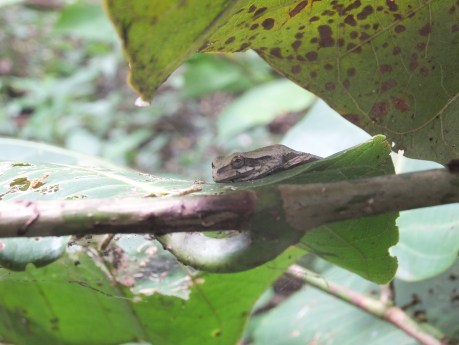
Since the rains started a month early at Palo Verde, there seems to be a superabundance of practically everything right now, including caterpillars. In my first two days, I collected over 170 caterpillars for one of the experiments I’m setting up (more about that later). I’ve also found a baby turtle…
a frog…
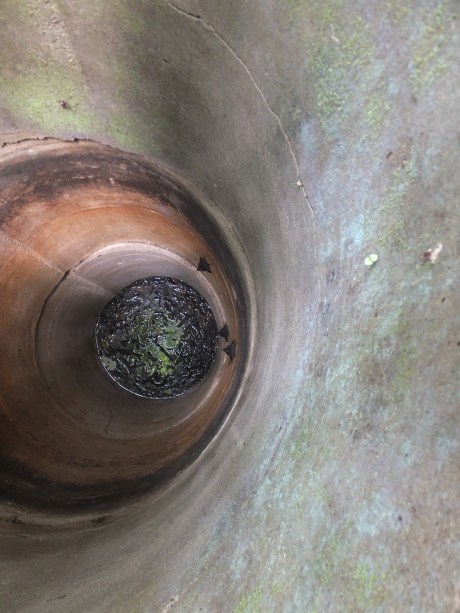
some bats…
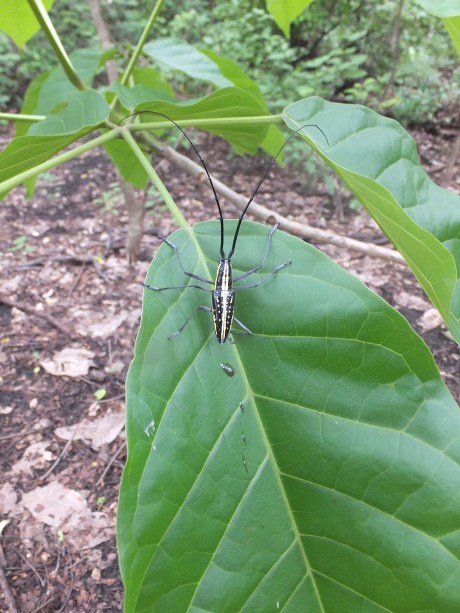
an awesome beetle…
and a crocodile and a tamandua, but I didn’t have my camera ready for those. Who knows what I’ll see this week?
Check your bags, check your tags May 25, 2017
Posted by stinawp in Uncategorized.add a comment
May 24, 2017
Welcome back to another two and a half months of semi-regular blog posts. Since May 22nd was the official International Day for Biological Diversity, I planned to tie my first post to that. I may still write something about it, but this post is going to be a public service announcement not to do what I did yesterday.
Public service announcement: When flying to Costa Rica, don’t make the normally safe assumption that you’ll be the only person with a particular style of backpacking pack on the plane. I was happily settled at my hotel when I opened “my” pack and discovered a stranger’s meticulously packed clothes. An hour or so later of talking to unusually unhelpful people at Southwest, and all I knew was that I was going to have to bring the bag to the luggage claim this morning, which would probably take an hour and a half each way in the morning traffic. They couldn’t even tell me whether my bag was still at the airport. So I went out to talk to the reception desk about a taxi.
Right after I got back, an email with the subject “I have your backpack!!” appeared in my inbox. It turned out that she’d made the same mistake I had, and had also left the airport before she realized it. She then executed a heroic piece of Google-fu and tracked me down based on the stuff in my pack. Even better, she was staying at a hostel only 40 minutes’ walk from my hotel. So we picked a shopping mall smack in the middle and agreed to meet there at 8 this morning.
Which we did, chatted a bit (Her: “At first, I thought they’d stolen all my stuff and replaced it with granola bars!”), and exchanged our identical green backpacking packs before heading out to tackle the rest of our trips. I’m still trying to decide whether I should email Southwest and let them know that we sorted our luggage issue out on our own.
The big picture, or why rice makes horses eat my caterpillars August 15, 2016
Posted by stinawp in Uncategorized.add a comment
I am now ensconced in my hotel and, I hope, sufficiently caffeinated to write this. (I only got five hours of sleep last night, or strictly speaking, this morning.) So the first proviso: I’m pretty tired right now. The second proviso is that the story I’m going to tell you is, like most stories, probably partially wrong. It’s what I’ve pieced together from conversations with people at Palo Verde over the last five years and my own observations. I haven’t been able to find written sources for anything but the most basic facts, sometimes because I haven’t had the time and sometimes because they definitely do not exist (yet). You have been warned.
Palo Verde is located in the province of Guanacaste, which is extensively agricultural and has been since the 17th or 18th centuries. There is cattle ranching in the drier areas and rice farming in the wetter areas. The ranching resulted in the conversion of lots of tropical dry forest into pasture. One of the reasons Palo Verde was made into a national park in 1978 was because it still had dry forest, although even a lot of that is secondary forest that grew back after being cut down in the past.
Another reason Palo Verde National Park was created was because its wetlands are important for tons of birds. Some live there year-round, some migrate from North America, and some migrate from South America. During the dry season especially, the water is practically carpeted with ducks, herons, egrets, and other birds. These water birds are also the biggest draw for tourists.
In the late 1980s, the Costa Rican government wanted to increase commercial rice production in the area between Palo Verde and the nearby town of Bagaces. They built a system of irrigation canals so that rice could be farmed year-round as a cash crop*. Then they established two brand-new villages and called them Bagatzi** and Falconia.
In the late 1980s and early 1990s, the population of a native cattail plant exploded at Palo Verde and turned huge areas of the wetlands into dense cattail stands that were bad habitat for the water birds, which prefer open habitats. The best explanation people have come up with for this sudden growth is an increase in available nutrients due to more fertilizer being used in rice farming. To deal with the cattails, the park started an intensive management program which is still in place today.
The program includes cutting the cattails, using huge tractors to smash up the roots, and managed grazing by a herd of cattle. This makes Palo Verde the only national park I’ve ever been to where the biggest animals you are likely to meet are livestock. While the cattle are usually kept in the marsh, they are sometimes driven along the road from one part of the park to another. This means that I occasionally needed to thrash my way a hundred feet into the forest and wait for five or ten minutes while a bunch of cows went by. And yes, they occasionally trampled or ate my plants and/or caterpillars.
But the bigger problem for me was the horses used by the people in charge of the cows (according to the internet, they’re called ganaderos in Costa Rica). When the horses aren’t being used, they’re allowed to graze free. There are a couple of grassy areas where they tend to stay (these are mowed occasionally, so I think they’re essentially impromptu pastures), but they don’t have to stay there. So the horses will wander along the road, chomping the tops off of plants. Since caterpillars often like the tops of plants, there were quite a few casualties. I still haven’t figured out how to analyze these data: I doubt the horses even noticed they were eating caterpillars, and a caterpillar “defending” itself from a horse makes about as much sense as a caterpillar defending itself from a falling tree (or a field biologist).
At any rate, I blame the rice.
*Traditionally, farmers grew only one crop of rice in the wet season. It would be one of many different crops grown for personal use, with little or nothing left over to sell. All this information comes from a Costa Rican researcher studying how land use and ownership have changed in Bagatzi and Falconia since their establishment. This is one case where there isn’t a definitive reference because it hasn’t been written yet.
** If you think this sounds similar to “Bagaces”, you’re right. Bagaces is the hispanicization of “Bagatzi” which was an indigenous name for someone or someplace in the region, although no one I’ve talked to knew what it referred to. The Spanish Wikipedia article on Bagaces references an academic as saying it’s probably from a particular language and probably means the place of the reeds. But the previous sentence in the article says that Bagatzi was the name of a local leader when the Spanish arrived in the 16th century. Costa Rica does not seem to have done very well at preserving its indigenous cultures, although I don’t know how much was deliberately destroyed. That’s not really the kind of thing you get into in a 150 page gift shop book, which is the only English-language history of Costa Rica I’ve been able to find.
(The History of Costa Rica, by Iván Molina and Steven Palmer, 1998. – I found this through Google Books and I think this is the right book; mine is back in the US and I think I have a revised edition. It was produced by the University of Costa Rica and I assume it’s accurate as far as it goes. But the tagline on the front of the 1998 cover is “Visit beautiful Costa Rica: Visualize its romantic past”. So it’s pretty clear they’d have a vested interest in not getting into things like forced cultural assimilation.)
T-shirt ideas August 11, 2016
Posted by stinawp in Uncategorized.add a comment
Earlier in the summer, I promised myself that, in honor of Alexander von Humboldt, I would write at least one blog post that would look at the big picture of Palo Verde and its surroundings and explore the connections between them. This is not that post. When I’m sitting in my hotel five minutes from the airport and have nothing more to worry about than what I want for dinner, I’ll write that post. In the meantime, I thought I’d share some ideas we’ve had for souvenir T-shirts over the years:
- “I donated blood to the mosquitoes of Palo Verde” (with a Red Cross symbol surmounted by a mosquito)
- “I was attacked by vampires at Palo Verde” (black with red writing, of course)
- “The Palo Verde militia” (with pictures of acacia ants, mosquitoes, and crocodiles) *
*Costa Rica is very proud of the fact that it hasn’t had a military since the 1940s, so there’s a common T-shirt illustrating their army of monkeys, air force of macaws, and navy of sea turtles. I think we should have a more local version.
Bucket lists August 8, 2016
Posted by stinawp in Uncategorized.add a comment
If I hadn’t rescheduled my return, I would be in San Jose right now and catching a plane tomorrow morning. It’s just as well I’m not in San Jose, because my field work bucket list still has the following items on it:
– Finish the never-ending experiment
– Make a video of me switching caterpillars for posterity (well, protocol documentation and/or science outreach)
– Finish measuring a bunch of leaves
– Collect leaf samples and all the plastic tape I’ve used to mark plants in the field
– Pack everything up
I’m making progress on all of those things and they will all get done by next Monday morning. But I’ve also been putting together a field site bucket list, which may or may not get completed. I have no idea when I’ll be back at Palo Verde, so I have some things I want to do one more time before I leave:
– Sit on the marsh boardwalk at night.
– Walk all the way down to the river.
– Hike up to all three of the lookout points.
I think those will be ambitious enough given how much time I have left here and how much still has to get done.
A plague of toads August 4, 2016
Posted by stinawp in Uncategorized.add a comment
When I went out to the field yesterday afternoon, I had to use my rubber boots for the first time in several weeks. They’d been sitting against the outside of the lab with the shafts tucked into each other. When I pulled them apart, no less than seven toads jumped or fell out. When I started knocking the boots against a post, an eighth tumbled out.
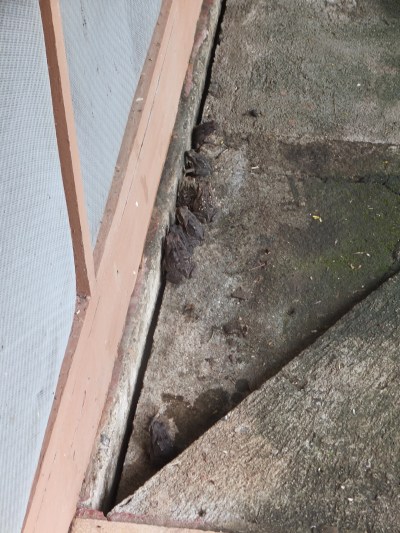
My erstwhile tenants
Despite their number, they left my boots in good condition. I’ll be glad if my subletter does as well.
An interminable experiment August 1, 2016
Posted by stinawp in Uncategorized.add a comment
I’m working harder than ever right now and have actually extended my stay here (I was supposed to leave a week from today) because of one apparently never-ending experiment. The short version: I have two caterpillar species that get attacked by parasites at very different rates. The species build different shelters. To test whether the shelters are affecting parasitism, I’m switching caterpillars into the other species’ shelters. There have been several problems with this experiment:
2014: It was really dry here and I couldn’t find enough caterpillars to work with.
2015: It was even drier and ditto.
2016: Almost every single one of the caterpillars I switched in June got eaten, mostly by spiders. Then I had to wait for the adults to appear and lay the next generation of eggs. To try and avoid the spiders, I collected lots and lots of just-hatched caterpillars and took care of them in the lab until they were bigger. For the last week or so, I’ve been putting the caterpillars back on plants and switching them. They are still being eaten by spiders, although at least I’m having better luck finding the bodies. (If I can collect the dead body, I can still use it in my analysis.)
The way things are going, this may wind up being retrofitted as an experiment in how long it takes caterpillars to be eaten by spiders.
In order to end on a lighter note, here’s today’s Frazz comic strip, which I found quite appropriate:

The person who shares the best alliterative sentence about insects will receive brownie points, which are redeemable for an actual brownie.
Caterpillar superheroes, part 2 July 29, 2016
Posted by stinawp in Uncategorized.add a comment
Caterpillars have hydrostatic skeletons, kind of like water beds. The big disadvantage to this is that if they spring a leak, it’s usually fatal. But one big advantage is that they can contract their entire bodies at once. This can lead to pretty impressive feats of strength:
 News That Stays News