Travelers and tourists August 6, 2013
Posted by stinawp in Uncategorized.add a comment
Tourists and travelers
I know analogies aren’t on the SAT (or the GRE) anymore, but this one should be pretty easy:
tourist : field station ::
A. clown : circus
B. student : school
C. gringo : Costa Rica
D. hospital : doctor
The correct answer is C.
Ecotourism is an important funding source for Palo Verde and many other field stations in Costa Rica. Most station biologists will admit this even as they use “tourist” as a pejorative. When pressed further, they may even admit that some tourists can be nice people too. I’ve reconciled this by thinking of short-term guests of the station as “visitors” until they do something worthy of being demoted to tourist status.
A couple from Canada gave me a view of this from the other side: they said that a friend of theirs described them as travelers, not tourists. I had to agree; for one thing, they had the self-awareness to ask the question, “do you all get sick of having people like us pop into the station?” It was a pleasure to be able to honestly answer “no”.
For better or worse, I basically demote people to tourist status when they annoy me. However vague and arbitrary that sounds, all the tourists I’ve encountered here have been annoying in one (or more) of these ways:
1. Group size. Travelers come singly, or in twos, threes or fours. Tourists almost always come in larger groups. Fortunately, Palo Verde is out of the way enough that we don’t get busloads of people unless they’re on some sort of course, but one night we had two sections of a university study abroad course totaling 75 people. I’m not sure what the minimum number for automatic tourist status is, but it might be eight—the number of seats at a table in the station dining room.
2. Reason for visiting. Travelers have specific reasons for going to Palo Verde or anywhere else. At Palo Verde, that reason is most often to see the huge variety of birds, but any specific reason will do. Tourists often seem to have picked Palo Verde at random, or at least from a list of equally meaningful (or meaningless) options. This can hold true even for large groups—I never figured out why the 75-person group was here in particular.
3. Politeness. Travelers tend to be friendly and curious, or at minimum, unobtrusive. Tourists tend to confuse researchers working at the station with staff working for the station, and expect assistance with things like reservations, hiking routes, and administrative questions. In spectacular cases, these expectations are not only not station researchers’ jobs, but aren’t anyone’s job: another biologist told me that at a different field station, she was given a cup to bus back to the kitchen.
4. Preparation and/or resilience. Travelers generally know what to expect and are prepared for it, and can roll with the unexpected. Tourists are unprepared and unpleasantly surprised, with the unpleasantness often engulfing the people at the station who have to deal with them. In one notable instance, a father and mother of two asked me about the boat tour of the river, about which I knew anything. The father then asked about possible hikes. I suggested a few, but said that most of them needed more than the sandals and flip-flops everyone was wearing. His reply that they all would change their shoes was interrupted by his wife, who declared that the black leather sandals she was wearing were her only pair of shoes. I escaped soon after, rather wishing I’d dusted off my German and pretended not to speak any English. Despite the fact that the father had said they were staying the night, I never saw them again.
The return of mondogo August 2, 2013
Posted by stinawp in Uncategorized.add a comment
June 17, 2013
The OTS course left this morning and we had mondogo for lunch again. This time when I presented myself in the kitchen, I received a bowl of soup with only two modest pieces and lots of vegetables. I’m not sure if this was because the cook accurately deduced who left mondogo in her bowl last time, or if the fact that I was a few minutes late meant that everyone else had already gotten most of the “good bits”. I was very pleased that there was no gagging this time.
Acquiring a taste for mondogo seems prudent, if only in self-defense: I think the cook would serve it at least weekly if possible. (In other words, if there aren’t any courses or tourists at the station.) The over-rational part of me (the one that tries to talk people out of their aversions to spiders, roaches, and the like) also maintains that avoiding mondogo solely because it is tripe makes about as much sense as avoiding tofu because it’s a solidified bean-water emulsion. However, I have no intention of asking for the recipe so I can make it at home.
Postscript, August 2nd: Mondogo has not been served again as the primary entrée, although it has occasionally made an appearance as an alternate one, usually on nights the station director is here, as it seems to be a favorite of his. I’ve passed up these opportunities and only partially because I only become aware of it as an option after I’ve filled my plate.
How ’bout them mosquitoes? August 2, 2013
Posted by stinawp in Uncategorized.add a comment
This is, I swear, the last I’ll write about mosquitoes. But they feature so heavily here for two reasons. First, they are a nearly omnipresent inspiration while I’m out looking for caterpillars, which is when I think up most of these posts. Second, they are a nearly omnipresent topic of conversation among people at the station. As far as I can tell, at Palo Verde mosquitoes fill the places in conversation normally held by the weather and sports elsewhere. The weather, because variation in the number of mosquitoes is generally greater than the variation in temperature, wind, or precipitation, and has a lot more to do with whether it is a “nice day” or not. Sports, because the contest of People vs. Mosquitoes is as all-consuming as any entrenched sports rivalry.
I would say that it was impossible to argue about mosquitoes, except that one of the OTS students and I disagreed ferociously about the word’s etymology. I gave it as an example of a Swahili word that had made it into English. She disagreed, and five minutes later one of the six rather shell-shocked people who had had the misfortune to sit at the same table for breakfast firmly declared the topic closed until someone could produce actual facts.
The verdict: “mosquito” is Spanish, ultimately originating from the Latin musca (fly). This is particularly embarrassing as there are a genus and family of flies called Musca and the Muscidae, respectively, which I taught in my capacity as Entomology TA. I stand corrected.
Butterfly Blizzard July 31, 2013
Posted by stinawp in Uncategorized.add a comment
June 14, 2013
When I was walking along the road, I came across a group of butterflies puddling in the road. “Puddling” is basically what it sounds like–dabbling around in puddles and damp earth–and it’s the butterfly equivalent of taking a vitamin.
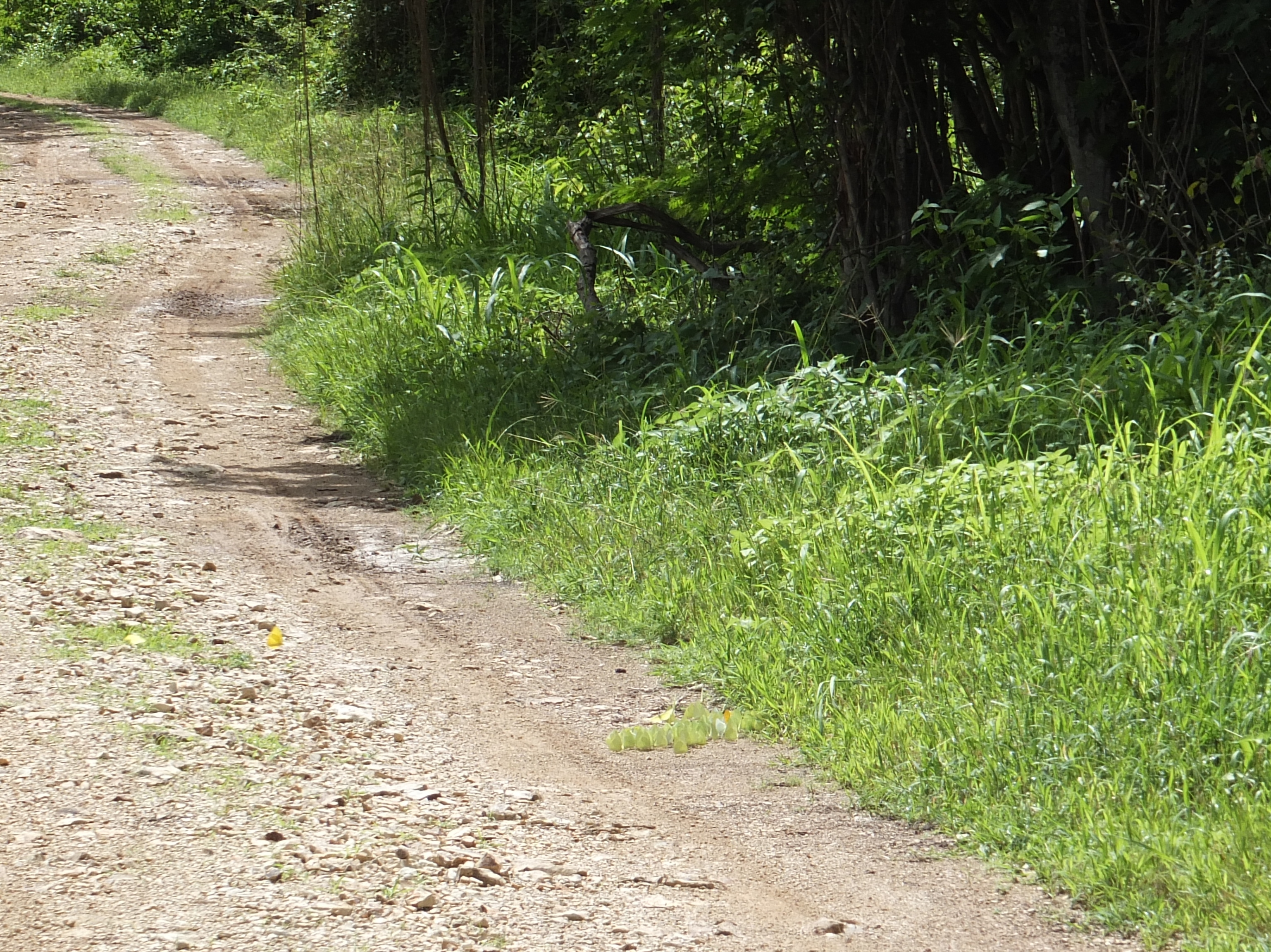
At rest…
As I got nearer, the butterflies boiled up and away like yellow confetti, flying along the road in both directions until the entire stretch of road was aflutter.
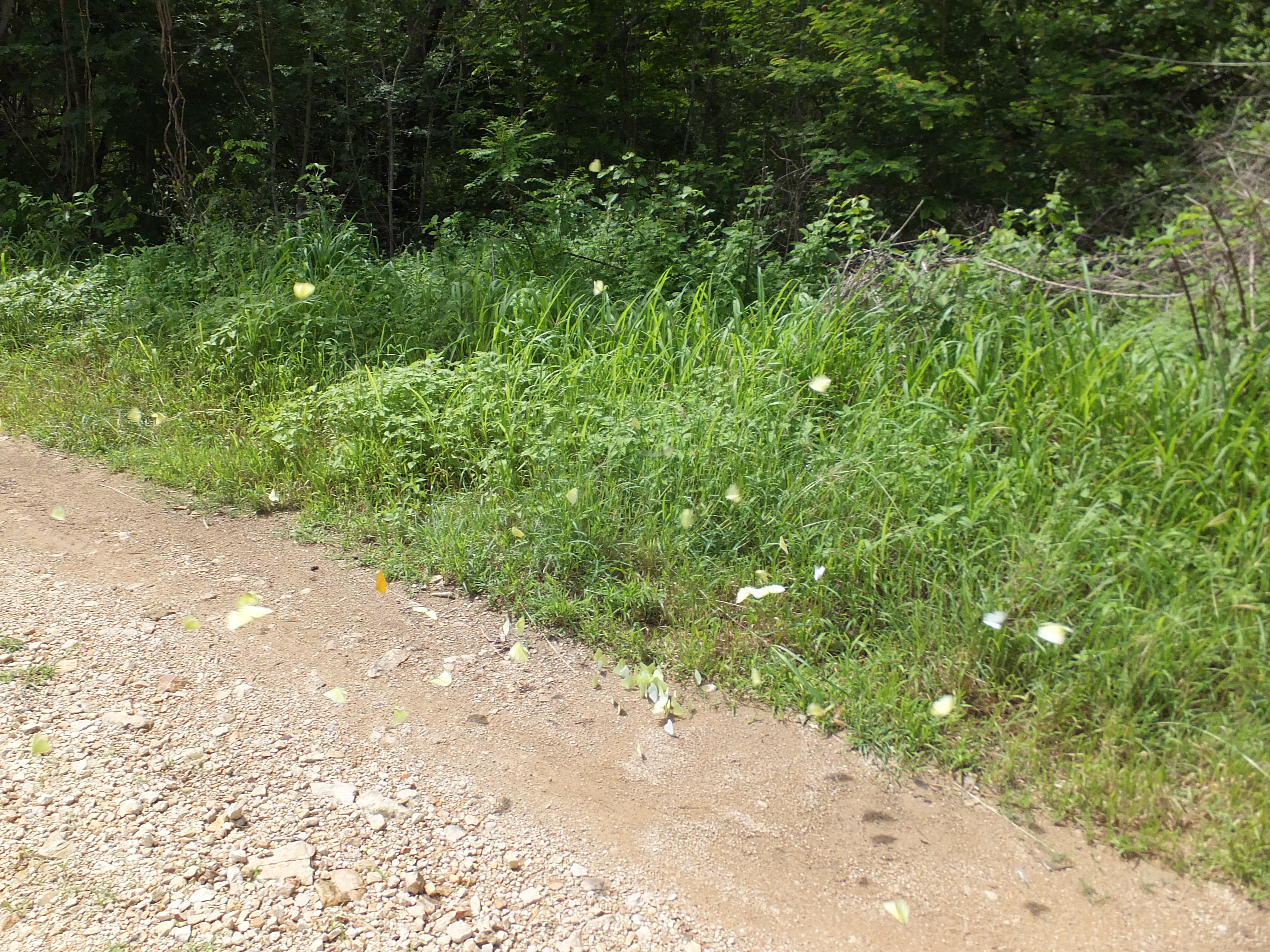
…going…
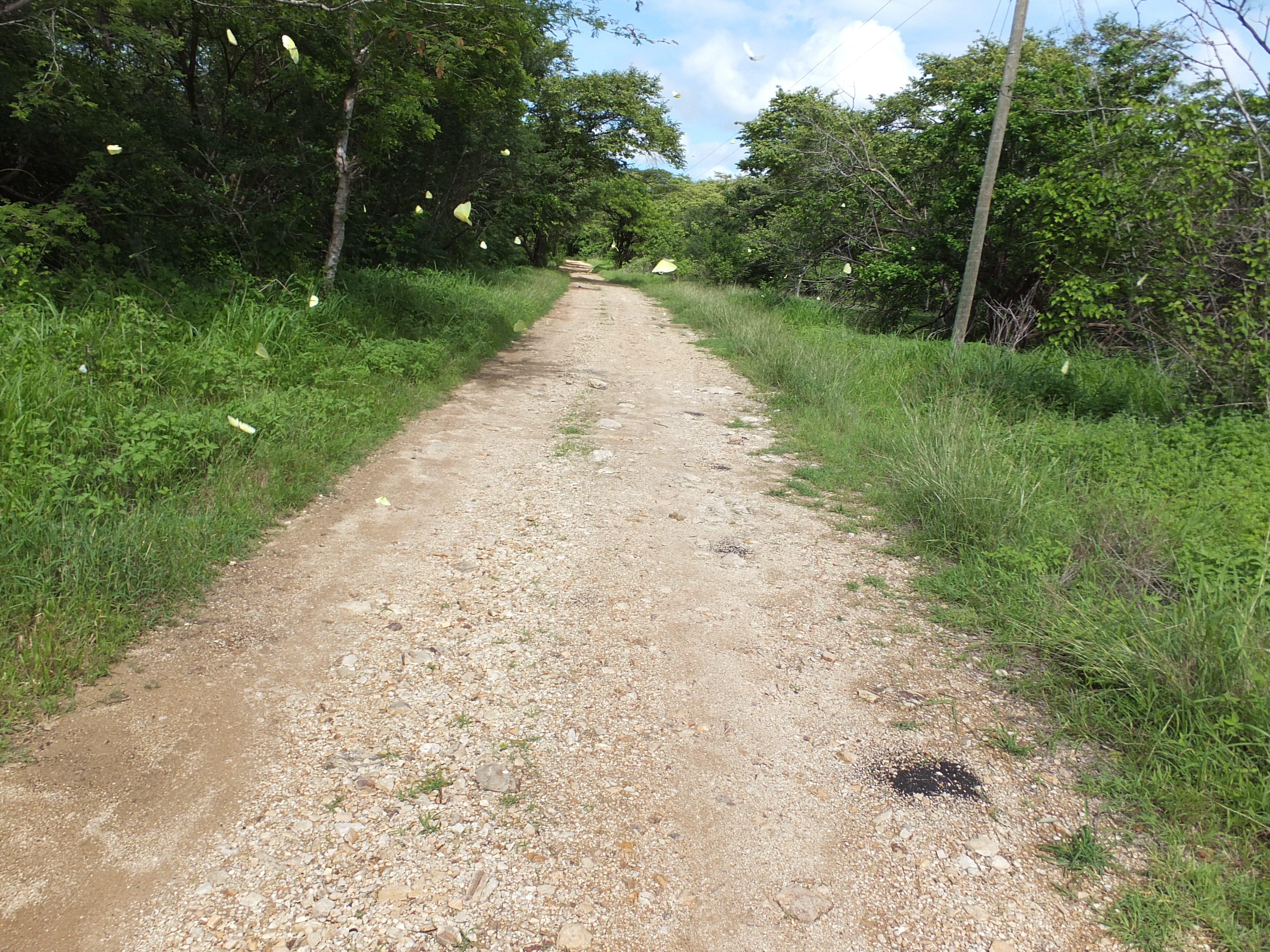
…gone.
Fifty ways to kill mosquitoes July 26, 2013
Posted by stinawp in Uncategorized.add a comment
I’d say this will make Paul SImon roll over in his grave, but he’s not dead yet. So maybe it’ll put him there.
In any case, it’s pretty easy to turn “Fifty Ways to Leave Your Lover” into “Fifty Ways to Kill Mosquitoes”… just replace the title verse and the list of ways. I won’t reproduce the whole song here, but here’s the new list:
Give ’em a smack, Jack. Turn on the fan, Stan. You need a decoy, Roy. Just get yourself free. Don’t make a fuss, Gus You don’t need to mush much. Just spray your sleeves, Lee And get yourself free.
The way of the mosquito July 21, 2013
Posted by stinawp in Uncategorized.2 comments
I know too much about various martial arts to seriously believe that there is a strike called “swatting the mosquito,” no matter how useful it would be at Palo Verde. It doesn’t matter—I can make up my own. In fact, any given day reveals that there is an entire repertoire of mosquito swats, determined by the mosquito’s location, what I’m holding, and what I’m trying to do at the same time. The most gratifying option is the loud, open-handed smack. However, this is a bad idea when a) I’m holding something in the attacking hand, b) smacking the mosquito would jar something in my other hand, or c) the mosquito is on my face. The third option goes especially poorly when I’m doing the smacking with my field notebook rather than just my hand. Sadly, I do this more often than you might expect.
Then there are the sneak attacks. I use back-handed smacks when I’m holding something, especially if the mosquito is on the back of my hand. Mosquitoes busy sucking on my eyebrows or behind my ears are surprisingly easy to smear off with a single finger. I once inadvertently took a similar tack with a mosquito biting my lip. I bit my itchy lower lip and discovered that a smashed mosquito tastes slightly bitter and makes the tip of my tongue tingle.
If nothing else, I can blow them off me, and sometimes (when I’m trying to photograph one of my caterpillars, for instance), that’s all I’m able to do. It’s not nearly as satisfying, but it keeps them off until I have the chance to smack them. The most effective evasive maneuver is simply to outpace them. As long as you stay above mosquito cruising speed, which by my very rough calculations is about 2.5 MPH, they’ll follow but they won’t usually try to land and bite.
Cool Thing Kludge July 15, 2013
Posted by stinawp in Uncategorized.47 comments
Sorry about the interruption in posting–I’ve been crazy busy.
Here’s a link to the cool video that should work: https://www.dropbox.com/s/ta1gjh1tm3h7d4y/PV%2006-10-13%20PV13-0014%20nice%20movie%20%28×8%29.wmv .
Let me know if it isn’t working.
What my caterpillars and I do all day July 6, 2013
Posted by stinawp in Uncategorized.add a comment
The caterpillars eat, digest, excrete, and occasionally build new shelters, shed their old skins, or pupate. Or get eaten alive by parasitoid wasp or fly larvae from the inside out. Then they get up the next day and do it all over again.
My days are only a little less repetitive. After breakfast, I go out and collect between four and six caterpillars, which is the number I can comfortably process in two or three hours. Collecting the caterpillars can take as many as four or five hours, but often only two. I also have to collect new food for my captive caterpillars, some of whom can go through the leaves of a small plant in 24 hours.
Once I get back to the lab, I do the intake processing for my new caterpillars. This means that I take pictures of both them and their shelters and get them settled in Ziploc bags. I’m also collecting data on the quality of the plants the caterpillars are on, so I also weigh leaves from the plant (so that I can dry them out and determine how much water they had in them) and test how tough the leaves are. By the time I’m finished with this, it’s time for lunch.
The afternoon is spent taking care of the caterpillars I already have. This means feeding them, cleaning out their bags, collecting old shelters, and photographing any new shelters, new skins, or other interesting developments. This often takes four or five hours. When I’m done with that, I upload all the photographs to my computer and label them. Then I go to bed so that I can do it all over again.
If I’m lucky, I get to see some really cool things while I’m doing all this. As soon as I figure out how to post it, I’ll put up a video of one.
Better living through entomology July 3, 2013
Posted by stinawp in Uncategorized.add a comment
Any visitors who come to Palo Verde during the wet season will be better off if they like insects. Aside from the omnipresent mosquitoes and the cockroaches (who, to be fair, really don’t do anything too noxious or obnoxious), there is always a parade of insects underfoot. Sometimes literally: I keep winding up with nocturnal beetles in my rubber boots and apparently don’t do a good enough job of shaking them out. The beetles then try to crawl out while I’m wearing the boots, with limited success. While picking them off my socks, I made a half-hearted effort to identify them and decided to call them tenebrionids, although I have no idea if that’s actually correct. Playing the name game also helps when dining: I learned that the minute insects walking across my plate are beetles in the family Nitidulidae.
On the other hand, there are also some entirely enjoyable insects here. Palo Verde has the most preying mantises I’ve ever seen in my life. There are also some gorgeous true bugs and beetles, which are often twice as large as their temperate counterparts. And the awesomeness of Palo Verde’s Lepidoptera will be a topic for another day.
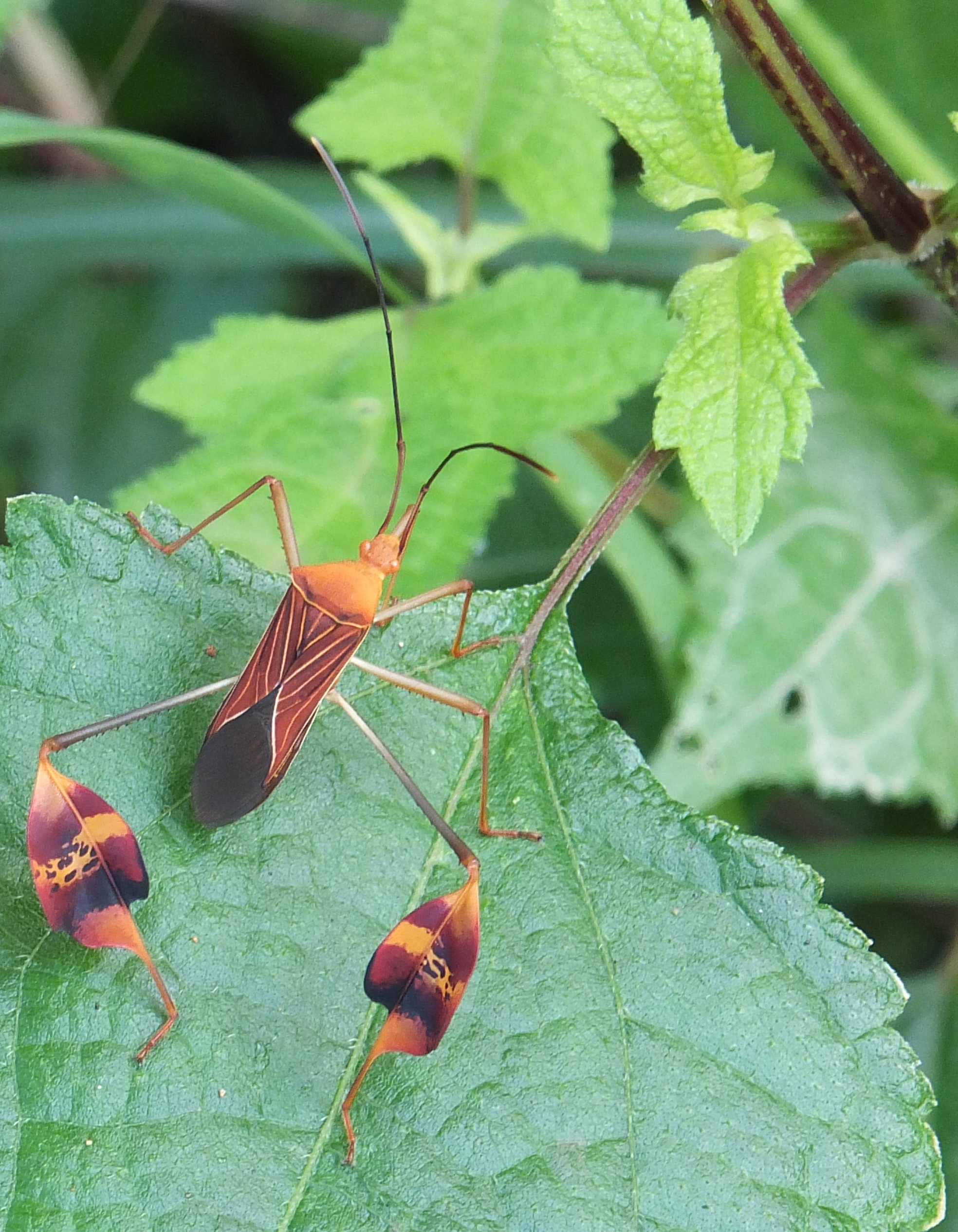
A leaf-footed bug (Family Coreidae)
Mirador July 1, 2013
Posted by stinawp in Uncategorized.add a comment
If you walk east from the station along the road and take the first marked trail on the right, you end up at the Mirador la Roca, the rock lookout. It’s a craggy outcropping at the top of a small ridge, and the elements only seem to sharpen its edges, not weather them.
Even though it’s only about 300 feet above the station, the mirador is an excellent place to get the lay of the land. The station at Palo Verde lies between two ridges that tower over the marsh like mountains but are probably, in terms of feet and meters, very large hills. The station is at the foot of one ridge, while the other is separated from us by miles of marsh, river, and farmland. The dirt-and-gravel road runs along the base of our ridge from east to west, gradually curving south from the ridge into the wetland and ending at the river. This topography makes it almost impossible to be lost, at least in the absolute sense of not knowing how to get back to the station.
Not only can you see everything from the mirador, you can hear it as well. The forest here is noisy, filled with raucous bird calls and the roars of howler monkeys, but the dampening effect of trees and leaves limits what you can hear on the ground. Up on the mirador, it seems like you can hear the entire park calling at once, with the addition of the bird and frogs in the marsh. Once I thought I heard a crocodile or caiman bellowing, but it might have been something else.
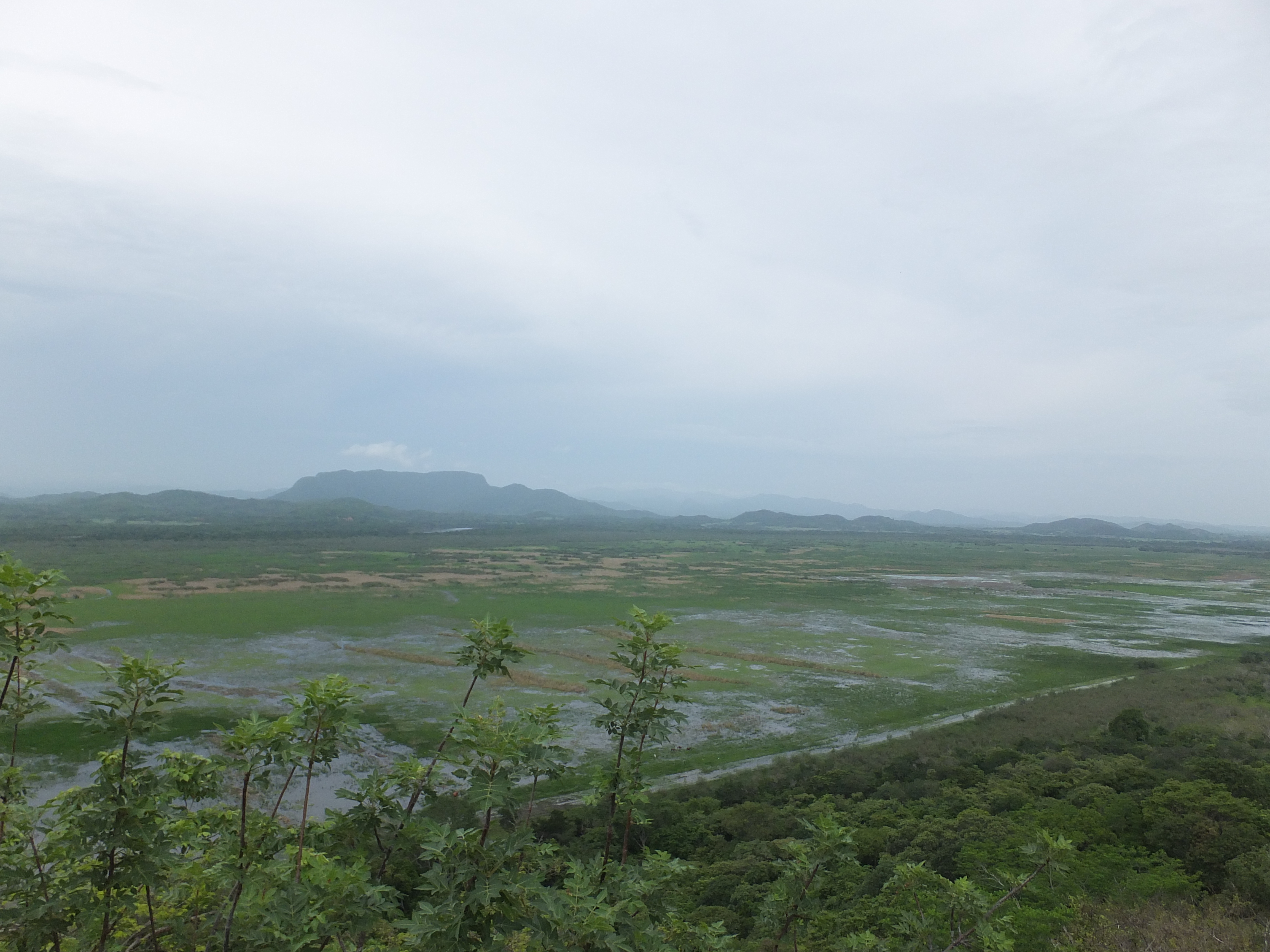
Looking south from the Mirador la Roca
 News That Stays News