Caterpillar superheroes, part 1 July 25, 2016
Posted by stinawp in Uncategorized.add a comment
I’m rather crazily trying to finish the final part of my field research and don’t particularly have the energy or inclination for even mildly insightful posts. Therefore, I will just keep posting goofy caterpillar videos until I run out of them or the work slows down.
This is a caterpillar valiantly defending itself against a parasitoid wasp that wants to lay her eggs in it.
Another fun caterpillar thing July 21, 2016
Posted by stinawp in Uncategorized.add a comment
Insect circulatory systems are weird. (From the viewpoint of a mammal, at least.) Instead of a comprehensive system of blood vessels, an insect only has an aorta that runs along the top of its body. It’s open at both ends and pumps fluid from the tail end up to the head. A week ago, I collected a big caterpillar that has very little pigmentation on the top of its body. As a result, you can see the heart pumping.
An excellent caterpillar July 18, 2016
Posted by stinawp in Uncategorized.add a comment
Last Thursday, I spotted this on a leaf:
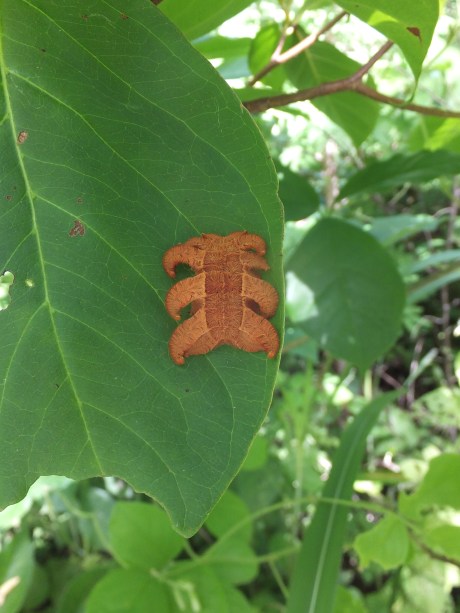
When I was showing the photo to everyone back at the station, everyone thought it looked so cool that I agreed to collect it and rear it, even though it has nothing to do with my project. (We’ll release it when it turns into a moth.) It was also an opportunity to take more photos.
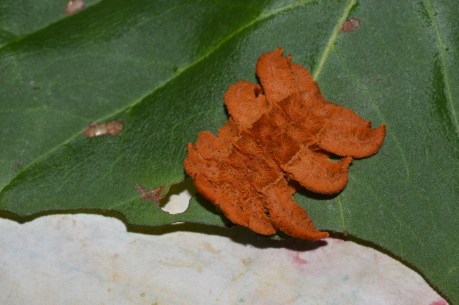
If you’re trying to figure how on earth this is actually a caterpillar, a side view might help:
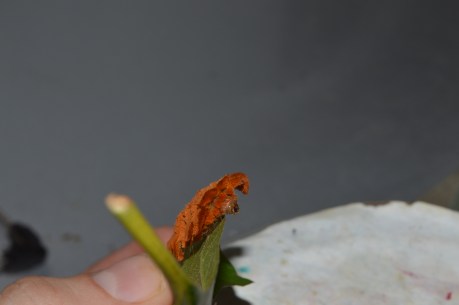
This caterpillar belongs to a family of caterpillars (the Limacodidae) that are commonly called “slug caterpillars” because their abdomens are flat and sticky, rather than having little mini-legs like most caterpillars. They also tend to either be very hairy, like this one, or smooth and featureless. On a lot of species, the hairs sting like nettles, but this caterpillar’s hairs are very soft and don’t sting, for which I am appropriately grateful.
The species is Phobetron hipparchia.
Fly-bys July 14, 2016
Posted by stinawp in Uncategorized.add a comment
July 12, 2016
On the heels of my last post, a nature photographer arrived at Palo Verde. She and her guide arrived in the late afternoon and left before lunch the next day. I guess they got some good photos—apparently a laughing falcon just sat on a branch and “posed” for them—but I’m sure they only got to see a fraction of what they could have if they’d stuck around even a bit longer.
I’ve always been confused by the people who come and go in less than a day, although since I talked a friend into driving from San Francisco to Yosemite so that we could spend twelve hours there, I can’t judge. Instead, it makes me realize how little I know Palo Verde even now. I walk the same stretch of road every day in the morning from June to August, but I don’t know what it’s like in the middle of the night or in November. And I’ve barely seen the rest of this half of park, let alone the other half, which I’ve visited exactly once.
The second-rate photo gallery July 11, 2016
Posted by stinawp in Uncategorized.add a comment
The problem with trying to take photos for a blog while doing field work is that I don’t really have time to wait for the right lighting for a scene, or hope that an animal will come closer or stop moving. I take one or two photos and they either turn out or they don’t. Here are some from the second-rate gallery—they weren’t totally disasters, but they don’t have enough detail be particularly interesting in and of themselves. I guess they might help prove that I’m not making things up.
Exhibit A:
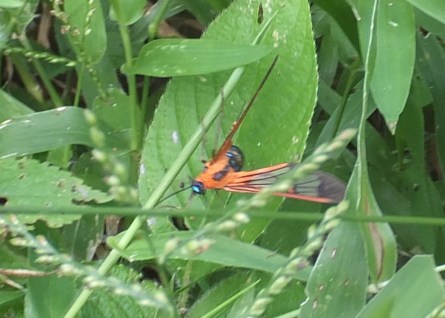
This is a moth I saw that looked like the love child of an orange-winged butterfly and a metallic blue wasp. It’s from a family of moths called Sesiidae, which all have skinny wasp-like wings, frequently with clear spots on them. This one kept crawling and flying around, even though it was having trouble getting anywhere.
Exhibit B:
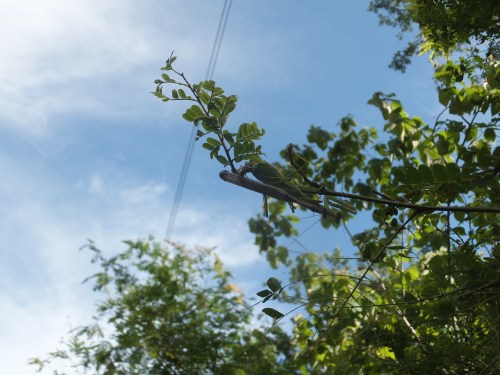
A pair of praying mantises mating. Honest. Taking photos of anything in a tree backlit by the sky is hard. On my way back, I wasn’t able to find them again, so I don’t know whether the male survived the experience.
Exhibit C:
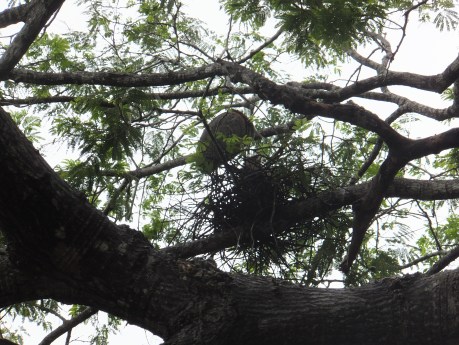
Speaking of backlighting, there’s pair of bare-throated tiger herons nesting in a tree right by the lab. Which is cool, except the nest is right over a path and there’s about a five-foot-wide bird poop splash zone. Tiger herons are pretty big.
Informative errors July 7, 2016
Posted by stinawp in Uncategorized.add a comment
July 7, 2016
Since I started working seriously on my Spanish, I’ve been paying a lot of attention to native Spanish speakers who are generally fluent in English and the mistakes they still make in English. I figure that those persistent mistakes can probably show me where I’ll be especially prone to mess up in Spanish, and what the correct usage would be. For example, the graduate student/naturalist here frequently says “I don’t have nothing”, etc. because double negatives are perfectly acceptable in Spanish.
Because my Spanish is so rudimentary, I can’t provide a comparable sampling of English-language errors in Spanish. However, last week I did wind up providing an informative cultural error. After some people walked into the dining room 15 minutes late, the other naturalist turned to me and said, “You don’t have provecho in English, do you?” I agreed that we didn’t.
Provecho, which I would translate as bon appetit or “enjoy your meal”, is something that Costa Ricans say to one another, not just at the beginning of a meal together but, as far as I can tell, whenever they see someone eating. What happened was that the latecomers walked in, said provecho, and everyone at our table (except me) said provecho or provecho igual (“enjoy your meal too”). I am also really bad at walking into the dining room and offering a provecho to the room in general.
One thing I haven’t really figured out is at what point social anonymity excuses one from wishing someone provecho. People who have just arrived at the station, don’t know any of us will, and are sitting at another table will still say provecho as they walk by. But I think the small size and isolation of the field station may increase the sociality of visitors. I certainly don’t remember people wishing strangers provecho in the roadside eateries the buses stop at. And the image of a waiter and party walking through a restaurant provecho-ing every table they pass strikes me as rather ridiculous. Also quite annoying to the other patrons.
Sorry, Henry July 4, 2016
Posted by stinawp in Uncategorized.add a comment
After listening to The Invention of Nature, I discovered that the library has Walden as an audiobook and read/listened to it for the first time. I’m a little ashamed to admit that, but that’s not why I’m apologizing to Thoreau. After a discussion of food and what he ate in his cabin, he moves into a metaphysical tangent about how the most spiritual and intellectual people eat very little. He backs this up with a natural history lesson about how caterpillars eat ‘voraciously’, but ‘perfect’ adult butterflies “content themselves with a drop or two of honey”. Ironically for someone who observed nature so frequently, he got this idea from a book: Kirby and Spence’s An Introduction to Entomology. And Kirby and Spence were flat-out wrong:
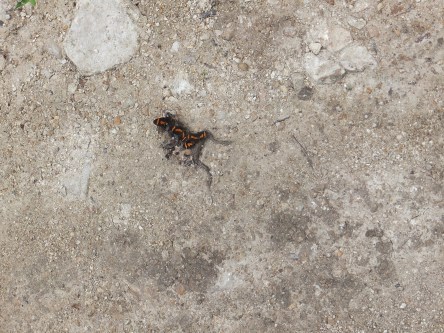
This is several butterflies “puddling” on a run-over frog. Butterflies will also drink from rotting fruit, bird poop, urine, and (maybe less objectionably as far as people are concerned) sweat and wet earth.
In short, the idea that butterflies just drink nectar from flowers is nothing more or less than…
A small mystery, half-solved June 30, 2016
Posted by stinawp in Uncategorized.add a comment
June 30, 2016
One thing that confused me practically every time I’ve walked past it the last two years is this little patch of plants on one side of the road:
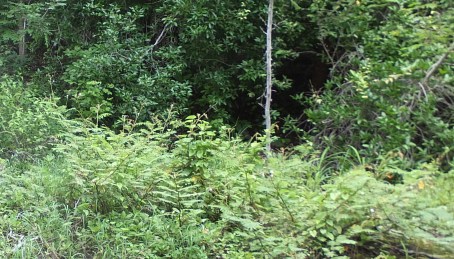
The reason I was confused was because those plants are a mimosa species that grows along the shores of the wetland. Not only is the road fairly far away from the wetland here, but the mimosas are growing on the wrong side of the road. During the drought, I could never figure out how there could be enough water there for the mimosas to survive, let alone thrive.
This year, the mimosas turned out to be perfectly aligned with either an extremely shallow pond or an extremely wide part of a creek that passes under the road at that point. There’s been flowing water there for the entire month, even though it hasn’t rained for a week.
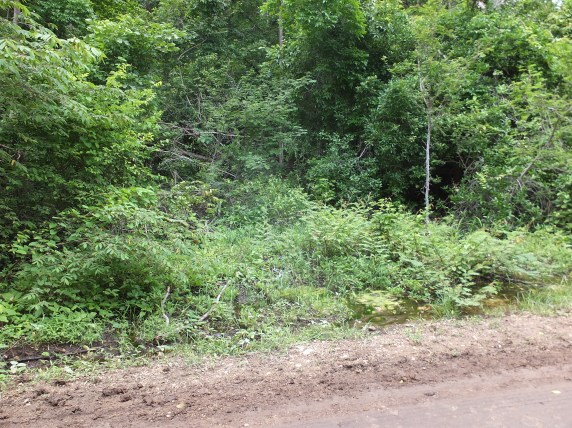
However, this raises two questions: First, where is all that water coming from? Given the limestone ridge close behind it, I suspect a spring. Second, how on earth did I not notice this stream in 2013? Unfortunately, that remains a mystery.
Book recommendation June 27, 2016
Posted by stinawp in Uncategorized.add a comment
This is about the time where I traditionally ask for book recommendations, in order to have plenty to listen to while doing labwork. This year, however, I seem to have quite a few books already lined up to listen to. So I thought I’d suggest one to all of you. It’s called The Invention of Nature: Alexander von Humboldt’s New World, by Andrea Wulf.
If you’re a biologist, Humboldt may already be familiar to you. If you aren’t, he was a German scientist and explorer who was arguably the first ecologist, in that he was most interested in how geography, climate, plants, humans, and other animals all interacted with one another, rather than cataloging individual species. He was also very good at explaining science in a variety of ways to a variety of people.
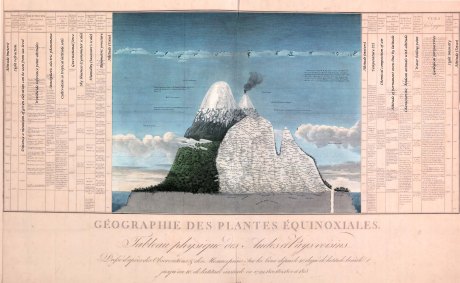
This is probably Humboldt’s most famous diagram. It’s a combination map and table of a really tall volcano in Ecuador, showing how all sorts of things change with altitude: temperature, pressure, the boiling point of water, the locations of different plant species, etc. He also compares it to other mountains.
I should warn that the book is not a particularly insightful biography. Wulf’s idea of probing a subject’s character is expressing surprise at a series of conflicting characteristics, rather than investigating those apparent contradictions. But she tells a good adventure story using lots of quotes from Humboldt’s travelogues and scientific publications. And since just one of Humboldt’s works was 34 volumes, this is a much more tractable read.
My favorite part of the book was the second half, which moved beyond Humboldt’s life to trace how he influenced 19th and 20th century thinkers. These range from the obvious (his books were one of the main inspirations for Darwin’s voyage on the Beagle) to the less obvious (Thoreau, John Muir, and the Art Deco movement). The inspiration Humboldt provided to all of them was his method of combining scientific data with sensory and emotional description. So I suppose, extremely indirectly, Humboldt also inspired my writing.
Happy birthday! June 23, 2016
Posted by stinawp in Uncategorized.add a comment
June 14, 2016
Don’t worry, it wasn’t my birthday today. There’s an OTS field biology course here and one of the students had her birthday. Which meant that we all got birthday cake for dessert at dinner. Every year I’ve been here there are two OTS courses that come in the middle of June and there’s always been at least one birthday while they’ve been here*. What’s really fun is that Palo Verde is always their first stop, so none of the students are expecting it. And there’s a ritual to it, so I can tell when I arrive at dinner that there’s a birthday even when I wasn’t told about it.
First, there’s no dessert set out like there usually is. This is a huge red flag that there’s birthday cake in the house. It also means that I’ll need to stick around longer than usual to get some, but it’s worth it. Sometimes a student or two will finish eating, leave, and need to be herded back to the comedor. Once it’s time, someone has to turn off the ceiling fans, because the candles won’t stay lit long enough for the birthday person to blow them out. Sometimes the students notice the fans are off, but they never seem to guess what’s going on. Then the lights get turned off, which definitely gets everyone’s attention, and they bring the cake out of the kitchen.
Finally, there is a rousing, more-or-less incompetent rendition of Feliz cumpleaños and the cake is served. In Costa Rica, it’s customary for the birthday person to cut the cake for everyone else, so it can be a while before they get to eat any. But the cake is definitely worth the wait. This cake was chocolate with dulce de leche as frosting. Delicious!
* Statistically, I guess this makes sense. If you have 35 people staying for 10 days and they each have a 1/365 probability of having a birthday on one of those days, the probability that someone will have a birthday during those 10 days is 96%. (1/365*10*35 = 0.96)
 News That Stays News