An Apology for Foie Gras December 16, 2010
Posted by Jason in Uncategorized.add a comment
Serious Eats, a food blog, has put together a considered examination of the ethics of foie gras. I had always been content to let my moral intuition decide that this particular practice was decadent and cruel, but I see now that I was guilty of anthropomorphizing the ducks.
Humans have a single passageway leading from their mouth down into their neck. From there, it divides into the esophagus, which leads to the stomach, and the trachea, which leads to the lungs. Separating these two passages is a little flap of muscle called the epiglottis. Try to force something past the epiglottis, and you trigger a gag reaction. It’s intended to make sure that the wrong things don’t end up in your stomach.Ducks, on the other hand, have completely independent tracheas and esophagi. Their esophagus goes straight from the mouth to the crop, while the trachea runs from the lungs and out the end of the tongue. That’s right: Ducks breathe through their tongues. The cartilage that surrounds their trachea (called the tracheal ring) is also a complete circle, as opposed to ours, which is C-shaped, making their trachea much sturdier and less prone to collapse. What this means is that you can place a feeding tube in a ducks throat, and it can sit there indefinitely, neither gagging, nor suffocating.

Credit: Julia

Portraits of Power December 16, 2010
Posted by Jason in Uncategorized.add a comment
A heartfelt obituary of Richard Holbrooke, American operator, and an Esquire profile of Harry Reid:
He worked in the mines as a child, in the dark with his silent father, scratching at the earth well after all the gold was gone. And after that he was a determined if not particularly skilled boxer. No knockout puncher, his best punch was a left jab, and he knew how to work the body, and so he won more than he should have. Once he was sparring with a pro, well out of his weight class, and he remembers that the next day his forehead was sore from the beating he took.
Gaming Satisfaction December 16, 2010
Posted by Jason in Uncategorized.add a comment
Why can you feel satisfied after ten minutes of looking at The School of Athens, when it takes you 20 hours to feel satisfied with GTA IV or 200 hours to appreciate WOW? What does this have to say about the nature of games? The comments section for this one is particularly good.
Contrast that piece with this New Yorker profile of Shigeru Miyamoto, the creator of Mario, Link, Donkey Kong and the like. The piece is obviously written by an old, clueless non-gamer, and even after you account for the briefing he has to give to the uninitiated, the story is obese. It has its pockets of flavor, but you can imagine the scene- writer gets nothing out of interview with Japanese demigod, decides to cover his tracks with drawl.
I suspect that the higher-ups in the New Yorker knew better, but someone prevailed on them to make this an idiot-proof introduction to video games. It reminds me of that passage in Zen and the Art of Motorcycle Maintenance, where the narrator claims that they get the man with the least-organized mind in the assembly line to write the repair manual.
Credit: Julia
Role-Playing The Wire December 16, 2010
Posted by Jason in Uncategorized.1 comment so far
The characters of The Wire, by Dungeons & Dragons Alignment:
(click to enlarge)
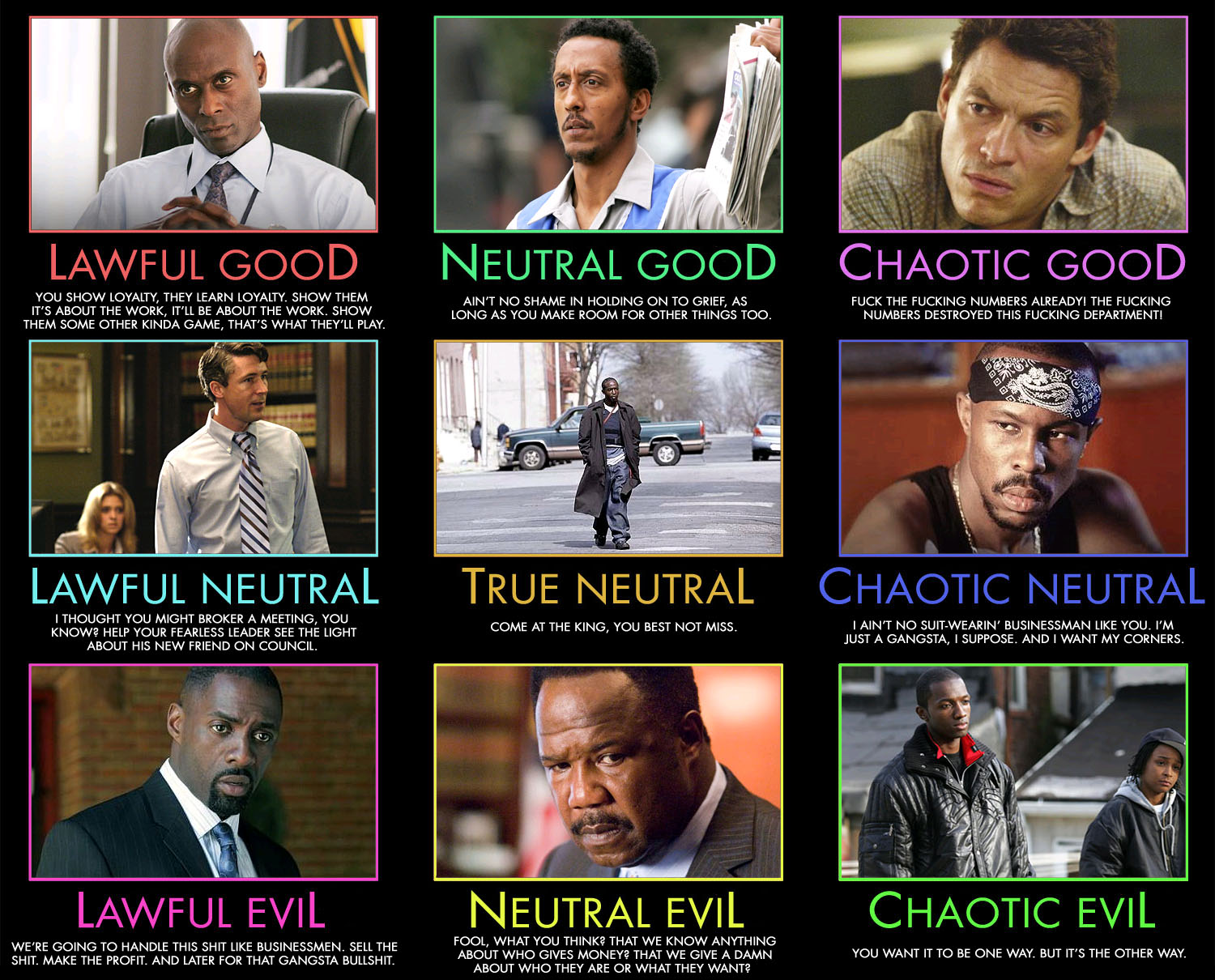
Credit: Kottke
Pound of Flesh December 12, 2010
Posted by Jason in Uncategorized.add a comment
Under what conditions would you be willing to read (or write) a book replete with ads?
Calculating Catastrophic Risk December 11, 2010
Posted by Jason in Uncategorized.add a comment
In honor of my risk-adverse streak, I’m going to repost an entire article from Joel Katz’s blog.
Deepwater Horizon
Folks who know me know that I love to read reports of accident investigations. I tend to find aviation accident reports the most interesting, but I also read reports of pipeline accidents, industrial accidents, and the like.
Generally, accidents fall into one of several categories. There are the sudden catatrophic failure accidents such as TWA flight 800 or American 587, the one really stupid thing accidents such as the Chalk’s air crash or the crash that killed Aaliyah, the long chain of small things accidents such as the Piper Alpha disaster or the gas pipeline explosion in Rancho Cordova in 2008.
However, the Deepwater Horizon disaster seems to be in a category all by itself. Just from what we know already, and we may have a very incomplete picture, the number of ‘very stupid things’ hovers at around seven. And these are some mind-bogglingly stupid things.
Let’s start with the blowout preventer. This is a critical piece of safety equipment. It’s so critical, and its failure can be so catastrophic, that key portions of it are redundant. For example, it has two control modules. Well, one of those modules had a bad battery. But that wasn’t considered particularly important to fix. Why? Because it was redundant — there was another battery in the other control module.
This is so mind-bogglingly stupid it’s hard to know how to point out how stupid it is without just blubbering in shock. What if there was an undetected problem in the second control module? That’s the reason they’re redundant in the first place.
But it gets worse. The other control module had a problem with a mechanically-operated valve. That was considered non-critical because there was a similar valve in the other control module … the one with the bad battery. It’s hard to point out how stupid this is without cursing.
Then there was the negative pressure test. This is a key test to assess the integrity of the well prior to removing the mud that prevents the well from blowing out. Well, the well failed the test. Managers decided that even though the test had failed, it was still possible that the well’s integrity was uncompromised — there are ways the test can report a problem when there is none. So they considered the test to have been passed even though it was failed.
Again, it’s hard to explain how mind-bogglingly dumb this is because it’s so obvious. In case you don’t see it, imagine someone goes to take a driving test to get their license. They do terribly, they run over cones, they show no lane control, and so on. But then you find out their baby sister was yelling all night the previous night, they didn’t get much sleep, and their nerves are shot. That can explain a failed driving test — the bad test doesn’t prove they’re not a good driver under normal conditions. So, you give them their license. Of course, the problem is, you have no reason to believe they are a competent driver, which is what the test was supposed to assure.
And this really is just the tip of the iceberg. Once the mud was removed, there were indications of a serious problem 40 minutes before the crew made any attempts to even assess the condition of the well much less try to regain control of it.
This is the worst of what we know so far. Let’s hope this remains the only disaster in this new category — long chain of astonishingly stupid actions that miraculously didn’t cause a disaster until now because of dumb luck.
Things this article makes me worry about:
1. E.T. The list of things that had to go wrong for the oil spill to happen seems to be as long as the list of things that need to go right in the Drake Equation to give us an intelligent neighbor.
2. Nuclear war. A lot of things stop a lot of other things from going wrong, but you never know which redundant system will develop a bad battery. Here are some examples of Cold War mishaps that could have led to nuclear war:
1956, Nov.5: Suez Crisis coincidence.
British and French forces were attacking Egypt at the Suez Canal. The
Soviet Government had suggested to U.S. that they combine forces to stop
this by a joint military action, and had warned the British and French
governments that (non-nuclear) rocket attacks on London and Paris were
being considered. That night the U.S. military HQ in Europe received
messages that:
(i) unidentified aircraft were flying over Turkey and the Turkish
air force was on alert
(ii) 100 Soviet MIG-15’s were flying over Syria
(iii) a British Canberra bomber had been shot down over Syria
(iv) the Russian fleet was moving through the Dardanelles.
It is reported that in U.S.A. General Goodpaster himself was concerned
that these events might trigger the NATO operations plan for nuclear
strikes against U.S.S.R.
The 4 reports were all shown afterwards to have innocent explanations.
They were due, respectively, to:
(i) a flight of swans
(ii) a routine air force escort (much smaller than the number
reported) for the president of Syria, who was returning from a visit to
Moscow
(iii) the Canberra bomber was forced down by mechanical problems
(iv) the Russian fleet was engaged in scheduled routine exercises.
1962, Oct.25: Duluth intruder.
At around midnight on 25 October, a guard at Duluth Sector Direction
Center saw a figure climbing the security fence. He shot at it, and
activated the “sabotage alarm”. This automatically set off sabotage
alarms at all bases in the area. At Volk Field, Wisconsin, the alarm
was wrongly wired, and the Klaxon sounded which ordered nuclear-armed
F-106A interceptors to take off. The pilots knew there would be no
practice alert drills while DEFCON 3 was in force, and they believed
World War III had started.
Immediate communication with Duluth showed there was an error. By this
time aircraft were starting down the runway. A car raced from the
command center and successfully signalled the aircraft to stop.
The original intruder was a bear.
1968, Jan.21: B-52 crash near Thule.
Communication between NORAD HQ and the BMEWS station at Thule had 3
elements:
1. Direct radio communication.
2. A “bomb alarm” as described above.
3. Radio communication relayed by a B-52 bomber on airborne alert.
On 21 January, 1968, fire broke out in the B-52 bomber on airborne alert
near Thule. The pilot prepared for an emergency landing at the base.
However the situation deteriorated rapidly, and the crew had to bale
out. There had been no time to communicate with SAC HQ, and the
pilotless plane flew over the Thule base before crashing on the ice 7
miles offshore. Its fuel and the high explosive component of its
nuclear weapons exploded, but there was no nuclear detonation.
At that time, the “one point safe” condition of the nuclear weapons
could not be guaranteed, and it is believed that a nuclear explosion
could have resulted from accidental detonation of the high explosive
trigger. Had there been a nuclear detonation even at 7 miles distant,
and certainly if much nearer the base, all three communication methods
would have given an indication consistent with a successful nuclear
attack on both the base and the B-52 bomber. The bomb alarm would have
shown red, and the two other communication paths would have gone dead.
It would hardly have been anticipated that the combination could have
been caused by accident, particularly as the map of the routes for B-52
airborne alert flights approved by the president showed no flight near
to Thule. The route had apparently been changed without informing the
White House.
Credit: Julia
Bromwich on Obama December 11, 2010
Posted by Jason in Uncategorized.add a comment
In an article on the midterm elections in the New York Review of Books, David Bromwich, one of my English professors (probably the polymath of the bunch), makes a real Obama-Carter comparison:
The Tea Party movement stands as the latest embodiment of a far-right strain in our politics that has passed episodically from partial control to a dominant grip on the Republican Party. It ascended in 1964, in 1980, in 1994, and has returned with a vengeance in 2010. The continuity has been concealed by the legend of Ronald Reagan as a moderate conservative. Reagan gave the nominating speech for Barry Goldwater in 1964, and his central issues in 1980 were Jimmy Carter’s want of manly resolve in failing to attack Iran and his lack of patriotism in letting Panama take charge of the Canal. Obama’s hands-off conduct toward the BP spill last summer was reminiscent of Carter’s Rose Garden strategy. Say nothing (both men reasoned) about a crisis that resists a methodical solution, and you will gain credit for candor. But it does not work like that.
This is probably what the lazy journos wish they could do when they trot out the old-said-saws: Obama as FDR/Clinton/Carter/Cleveland. That said, I think the thing Bromwich does best here is resist the Reagan hagiography we have become accustomed to reading.
Someone call the Ombudsman December 11, 2010
Posted by Jason in Uncategorized.add a comment
Mark Madoff, Bernie Madoff’s oldest son, has died, a suicide. He had apparently been unaware of his father’s fraudulence. The New York Times and the Wall Street Journal published two lurid articles about the death that were more financial muckraking and gossip mongering than heartfelt obit; this has to be a case of journalistic (or ethical) malpractice.
Is this a trend, part of the shifting standards of civility? A lot of obituaries these days try to be about more than the person who died. Often the death is used for some argumentative purpose, the way a book is often an excuse for an essay in a book review. C.f. this obit of Elizabeth Edwards in the Atlantic, which also aims an elbow at political wives, and this Time obit of Robert Byrd, which takes his death as an occasion to shovel scorn onto the Senate.
Juking the Stats in Novosibirsk December 11, 2010
Posted by Jason in Uncategorized.1 comment so far
A puppet-party candidate in Russia got mad at the system and tried to campaign on her own, but minders from United Russia & the Russian government shut her down. The article contains an interesting piece of speculation about the true role of democracy in Russia:
Regional chapters of A Just Russia had tried to wage authentic campaigns before, but the one here in October was among the fiercest. The headquarters of A Just Russia in Moscow referred to these newly assertive tactics as the “Novosibirsk experiment.” It viewed the election as a warm-up for national parliamentary balloting next year.
The party’s national leader, Sergei M. Mironov, who is head of the upper house of Parliament, visited the city and channeled funds to the campaign. (Because of Mr. Mironov’s prominence, the local authorities did not hamper him when he held campaign events here, his aides said.)
Mr. Mironov is a Putin ally, but he began drawing a distinction, vigorously opposing Mr. Putin’s party while usually — though not always — backing Mr. Putin himself. It was not clear why Mr. Putin tolerated this. There was speculation that he thought that competition would keep United Russia’s regional cadres from becoming complacent.
Something tells me that China wouldn’t do things this way, if it ever decided to set up a multiparty system. I’m not quite sure why I think this, but my instinct tells me that their elites would fight the implementation of such a system with their bottom RMB, but that once it was in place they would go and stage an open competition.
China: Not Ready for Primetime December 9, 2010
Posted by Jason in Uncategorized.2 comments
A hilarious article from The New York Times about the Confucius Peace Prize, the award that the Chinese government put together at the last second to counterprogram the Nobel Prize Committee’s Peace Prize Ceremony.
The winner, Lien Chan, a Taiwanese politician friendly to the Chinese Communist Party, did not show up at the conference room in downtown Beijing where the prize committee had gathered. Nor has he expressed any intention of accepting the prize, which comes with a $15,000 award.That presented the committee with a problem: Who would collect the prize?
In a room packed with mostly foreign reporters, a young girl who apparently had no connection to Mr. Lien accepted a 10-inch circle-shaped statuette. There was little fanfare — the prize committee uttered just a single line announcing the winner, then took questions.
At that point, the committee was peppered with inquiries about its views on the Nobel Peace Prize and Mr. Liu.
Tan Changliu, chairman of the committee, made every attempt to steer the conversation away from that subject. In a page seemingly taken from the Harry Potter books, he tried to avoid referring to Mr. Liu by name, instead calling him the man “with the three-character name.”
The excellent China Real Time Report in the Wall Street Journal also ran a story about the prize. This farce puts China in unfortunate company:
The Confucius Prize isn’t the first rival the Nobel Peace Prize has weathered. In 1937, Adolf Hitler established the German National Prize for Art and Science as an alternative to the Nobel, which a year earlier had been awarded to German journalist Carl von Ossietzky. Thirteen years later, the Soviet Union announced the International Stalin Prize for Strengthening Peace Among Peoples, renamed the Lenin Peace Prize in 1989 and discontinued after the collapse of the USSR in 1991.
What this reminds me of most is actually the 2008 campaign. Remember when Barack Obama went to speak in Berlin at the Tiergarten? Well, John McCain was busy meeting reporters in Columbus, Ohio, at Schmidt’s Sausage Haus und Restaurant, which is in the German Village district.
In what was clearly not a coincidence, McCain spoke with reporters shortly before Obama began his speech at Berlin’s Victory Column.
At the same time, The Republican National Committee was running anti-Obama ads in Berlin, Pa., and other namesake villages in Wisconsin and New Hampshire.
12/20/10 UPDATE:
Our anonymous commenter may have been right. We’re starting to see retractions, like this one from an article in the Huffington Post– you can read the whole article here.
* The Confucius Prize may not have been as directly linked to the Chinese government as early reports in the international press and this blog post when it first appeared suggested. As of now, much about the prize remains murky. What we do know is that the head of the prize committee is reported to have told an AP reporter that, while his group was not an official organization, it “worked closely with the Ministry of Culture,” and that the idea for the prize was floated in mid-November in the Global Times newspaper, an officially endorsed organ tied to People’s Daily. The light coverage of the Confucius Prize in the Chinese press after it was awarded suggests that it may have had only limited official support from the beginning, or that efforts were made to downplay its importance once it became clear it was turning into a public relations fiasco.
 News That Stays News