A punishment, decreed against interpreters, detected of willful misinterpretation January 3, 2013
Posted by newsthatstaysnews in Uncategorized.1 comment so far
In the Saraswathi Mahal library, there were a few brilliant botanicals, naturalists’ renderings of animals, anatomical drawings, and an [aesthetically, if not morally] wonderful series of Physiognomic drawings by Charles Le Brun, showing the same man as a half-goat, half-pig, half-rat, etc. And also, Les Punitions de Chinois. I took down the caption for one, though I could not reproduce the accompanying diagram without a camera:
“A large piece of bamboo cane is placed behind his knees. This is trampled upon by two men, one standing on each end, and who convey more or less pain as they approach or recede from, his person.”
National Travels January 3, 2013
Posted by newsthatstaysnews in Uncategorized.add a comment
On Thursday evening, I walked out of my B&B into industrial and relatively affluent surroundings, got lost in the dark, and was for the first time here, a little bit afraid. It made me think that travelling alone is a little bit of a rite of passage: to find courage when, occasionally, you realize your utter inability to control your surroundings or your fate, resourcefulness before a myriad small puzzles and inner warmth to not just smile at but occasionally befriend strangers (You can guess which one of those is hardest for me). At any rate, there’s nothing for fear but to walk away or do what you came to do, so I paid an auto driver 40 rupees to drive what turned out to be a kilometer north (maybe he ripped me off), then turn left onto an unpaved, unmarked road (fair), drive down its bumpy and unlit extent for a hundred meters (very fair), and deliver me to the very last door of the barely lit and seemingly empty last section of the flying train station, with a suggestion that the ticket office would be out of sight in the gloom on the left (maybe I ripped him off). Mind, by empty I don’t mean deserted, I mean absolutely nothing in view but cement walls. To whom it may concern: sir, thank you for the flashlight, you’re a good friend, and I owe you one, for the Taramani flying train station stairwells just don’t have any lights.
A few hours and several mistakes later, I was standing around Koyambedu bus station, watching the paratha makers take little balls of dough, sling them at the hot iron, roll them out, flip them over, and then when they’re browned, pick the lot of them up and, to get just the right airy flakiness, literally punch them into submission. The reporter talking to them, on his way to write yet another fluff piece about temples and festivals for the Times of India, told me they make two thousand in a day. He also asked me if, in America, we have sex with our girlfriend’s mothers like he sees in the videos he watches. And then I hopped onto a bus to a different mode of existence.
If you ever hop such a bus in India, and it’s a sleeper, keep in mind that there are double-wide beds on one side of the bus (I slept on the other), and the two spaces therein appear to be independently sold to two riders of the same gender. This has confused me more than once here – I can’t really explain why american men touch each other so much less than american women. I’m not proposing we curl up with each other when we sleep, or hold hands on the street, but I can’t really justify why we don’t do it and women do. My friend suggests that maybe we’d be the same if we didn’t spend all of middle school randomly accusing each other of being impardonably gay.
At any rate, I arrived in Madurai at 9 in the morning, walked past a dozen auto drivers, picked up three fresh idly wrapped in a palm leaf, drank my first chai masala tea – cooled back and forth between two containers, and took off wandering in what turned out to be the precisely wrong direction.
Along the way, I passed a couple of weddings, saw the “bell jumbo restaurant” with a jovial little elephant (

a familiar elephant – someone else’s photo from online
) whom anyone who’s been in Chile will immediately recognize, failed to get directions from a woman who didn’t speak English – but was using it to read a trigonometry textbook, and failed to ask them from a woman in a head scarf who was reading about the way “changes in global communications have change the way meetings are planned and conducted”. Somewhere in there, my dependence on chai masala tea from the street began, along with that first beautiful palm leaf-wrapped dosa.
Eventually I found a road “70 ft to Periyar”, which turned out to mean that this was “70 ft road”, and that it would, in a few kilometers, lead me to Periyar. Just off 70 ft road lies the nearly finished giant three-dimensional Mondrian of an apartment building that shook me twice over: mildly because they painted some of the rectangles green, and severly because the scaffolding there, and almost everywhere I’ve been since, was built out of sticks, not metal or even two-by-fours. A little past this Swarnabhoomi tower (“not for rich people, only for famous people”), I watched a cow cross 70 ft road, too impressed to realize that I myself needed to cross, too, and that I’d squandered an unexpectedly safe opportunity to do so. I’ve gotten a lot better at this, both crossing the street safely an accepting that it’s never going to be safe, but it was still a little peculiar to stand on an onramp and feel a profound sense of relief because, at long last, I knew for damned sure I need only watch for traffic in one direction.
Eventually, I caught up with my friends, and we visited the Meenakshi temple, and it was big, and there were young men wearing black and orange dhotis running about everywhere, cutting queues and generally acting superior, which apparently as pilgrims they’re entitled to. Anyhow, it was big, and there was a hall of a thousand (actually 985) columns, and there were lots of statues. I cannot evaluate a Hindu temple as a believer, only as a traveler and perhaps a poor architecture critic, and as such I was wildly unmoved. I was surprised by this, an wondered a lot about cultural relativism, until I saw the temple in Tanjore. And then I realized that I just don’t like the Meenakshi temple, that I find its sculpture bland, its towers gaudy and its jam-packed atmosphere off-putting. But Tanjore! If you have ever seen Chola sculpture, and can imagine a two-hundred foot tower covered in it, then you have begun to understand. Every vertical element of the tower has a slightly different style, as does each horizontal each layer, so that in any given region, the columns and their capitals are slightly different from those to the left, right, above or below. I tried to sketch one such column: a strange, ridged, fluidly composed wonder that would have been right at home in the Sagrada Familia.
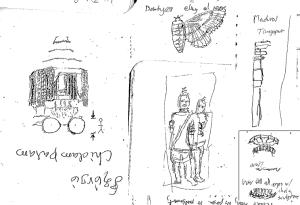
from my notebook, such as it is
It is, moreover, the case that many of these columns have smaller low relief images of temples inscribed on their bases, and that these temples themselves have columns. At this point, my dirty glasses, straining eyes, and the darkness conspire to limit my vision. I can only assume that after a thousand years, that must be as far as it goes. I should say though, that the style of these innermost columns was itself unfamiliar to me.
Now, of course, imagine that all the interstices are filled with Chola sculpture. I don’t know why it is so expressive, or so human. My best efforts to draw one such scene of Shiva and Parvati from the nearby museum (see above) does no justice to the richness of the human expression, or to the wonderful composition of the figures. Incidentally, I find myself absolutely innocent in the matter of my standing there, drawing these figures after the museum was closed. It could hardly be my fault if the person who went up into the tower to tell everyone to leave came down a different stairwell than I was climbing! Or if no one else told me to leave. Or if I was entranced with the tower, each floor of which has a progressively larger flower painted on the ceiling, except that it is actually the floors which are somehow imperceptibly shrinking, and not the flower that grows. Or if no one asked me to leave as I stood in the shade of the second floor, wondering quite why I might be sharing that shade with the skeleton of a whale.
In fact, I liked the Chidambaram temple better than Meenakshi, too. Even though I’ve somehow inherited my ancestral prohibitions against idolatry, and the gasp and the shoving of the crowd as the silver doors are draw aside to reveal Ganesh in the shadowy firelight somehow irritates me. I cannot understand the idea that it is not our experience of the divine that is heightened by this ritual, but that the god is in fact more present in this place than in others, and that this is because we have told him to be so. It seems presumptuous, somehow. I suppose communion is no less strange, and indeed rather more, and this sort of thing is just a matter of revelation, can only be accepted through faith. Maybe it’s just annoyance from being excluded from the symbolic power of an event, like when I watch American football, and try to care.
The lower stories of the temple Chidambaram are Chola, and the dusty sculptures, if washed off, are jet black. Somewhere near the entrance, there is a dancing Shiva (hence the Nataraja temple), his limbs covered in the orange and red powders I’ve come to associate with all things holy here. There is the impression of a flame in motion, which is very, very cool. The upper stories are still painted many colors, but not in such extravagance as Madurai. Somehow, it makes more sense to me.
What does not make sense are the chariots parked outside the gates. I tried to draw one (see above), but I can’t really convey the sense of a three story radio-flyer, for use on sparing occasion, as a conveyance for the God.
The Dream of the Yellow Autorickshaw December 23, 2012
Posted by newsthatstaysnews in Uncategorized.add a comment
I’m still trying to figure out how to deal with cultural expectations. When I share an expectation, through culture or choice, I accept it as a duty. When I find I do not share it, I can choose to. If I can make myself plain, why then I can also say something like “sorry, I don’t really like chocolate”, and be met with “oh, so you’re crazy?”, and reply “guess so”, and let that be that. As long as my rejection is idiosyncratic, there’s no offense, whereas something categorical like “oh, who eats chocolate?”, would reject the very validity of the expectation, and thus be insulting. I imagine vegetarians are terribly familiar with that distinction. Fortunately, for me, the idea that I might be asking who likes chocolate is so outlandish that people usually take this the right way. Of course, if someone had already, through ignorant good intentions, baked me a cake*, I’d likely eat some. Likewise, if I were a guest of a guest, and were specifically offered cake, I might accept to avoid letting my awkwardness reflect poorly on my host. The problem I have is when someone bakes me a cake and then says ‘$3.50 please’.
I have a strong expectation of being left alone. Maybe it’s because I’m an only child, and the american northeast is cold enough to let me be that way. That expectation is violated when a waiter comes over to put some food on my plate, momentarily empty, from another dish which is sitting right in front of me on the table. I don’t know whether the local custom would prescribe that I acknowledge the waiter every few minutes when he did this (distracting), or ignore the waiter (to me, rude). This one’s easy – never leave the plate empty, and I’ll be left serenely alone. I tend to perceive this being-left-alone as a matter of not wanting to trouble someone to do something for me, but the truth is that if it were infrequent, and done by someone wishing to express goodwill, then I might well be more okay with it.
What really drives me nuts is when someone in the hospitality industry does something for me that I’d rather do for myself. Perhaps this is because asking me to pay for a cake moves someone from the social to the commercial context. In that context, if done purposefully it’s a ripoff, and if done accidentally then it’s just bad business sense. Perhaps it’s because it is done in a deferential way, which feels servile to me – I’ve never been in a Chilean or American four-star hotel, so I don’t know if this is cultural. Perhaps it’s because doing something that does no one any good is humiliating to me. And it is this insult, the categorical rejection of the expectation as a useless thing to do, which gives me pause when I would resist.
Or maybe it’s just that I’m no good at tipping, actually. It just makes no sense to me to tip someone who hasn’t gone especially far out of their way. It’s like that tradition in classical music where the conductor/performers always leave the stage long before the applause ends, so that they can return to popular acclaim. I guess this is to say that I don’t understand my own culture either: it just seems disingenuous for them to leave when they know perfectly well we’ll keep clapping. Worse yet, they sometimes reemerge to dying applause, which promptly if unenthusiastically restarts, seemingly to save everyone embarrassment. The whole thing feels like a low-stakes version of that guy at South Station who begs for money, and says he’ll throw himself in front of the train if he doesn’t collect enough money to catch his bus, which leaves in <however long before the next northbound train comes>.
Perhaps it’s just a result of astonishing inequality, which allows someone to offer to do something I don’t want them to do, for trivial change. It’s like one of those behavioral economics puzzles. I feel self-righteous refusing to do what I don’t want to do, but mean refusing to do something I don’t want to do and also to hand over 40 cents (in the old sense of mean).
And the inequality here is astonishing, even in the wealthy areas. Somebody’s selling lunch for $1.25 in front of the 11 story tech building I work in. The areas between the buildings are unpaved, full of standing water and low concrete construction. Lord only knows what I’ll think when I’ve been out more.
Mind, the measures taken to oppose inequality seem somewhat counterproductive. In a state whose GDP grows at 12% a year, it’s impossible to keep everyone supplied with all the electricity they want*. Still, when there’s planned two hours rolling blackouts in Chennai, and blackouts of as much as 16 hours in neighbouring districts of Tamil Nadu, you know something’s wrong. Much as I hate getting price-gouged by NSTAR, raising prices until the demand dropped to the existing supply seems like a vastly more reasonable way of dealing with this problem, not to mention one that would help pay for the badly needed infrastructure. It’s interesting that you can see the current approach as price discrimination, where businesses that need continuous power are forced to buy generators, and so are in effect adding more production capacity to the grid, at a much higher cost to themselves than the state wants to charge ordinary consumers. However, it’s a chaotic, inefficient way to go about it. I admit I genuinely don’t know if poorer electricity consumers would prefer low rates to predictability – this may simply be a failure of imagination on my part.
While I’m at it, I do wonder about the elevated train which apparently looses 100% of revenue. I guess I should hold off comment until I’ve ridden it, but the city is said to have still failed to license commercial development of the stations, and failed to convince bus operators to move routes to service the stations (no one rides the train, so when the buses routes are moved, no ones rides them to the station, so the bus operators renege and go back). All I can vouch for is that the stations I’ve seen are huge and desolate, like somebody’d been selling cement by the pound…
One thing I have already experienced is the street. I now accept that traffic is space filling like a falling liquid, at least in its direction of motion. That if you pull a traffic vacuum between you and the edge of the road big enough for a motorcycle, one will appear, and just like that, where you are standing will be the middle of the road, and no longer the edge. That if you move quickly, in any direction, you may surprise someone. Someone driving rather fast, so that moving slowly but in plain view out of the way of a truck may be far better than surprising a motorcyclist. That I can sleep in an autorickshaw in a traffic jam, and be none the wiser.
Speaking of streets, I have devised a maximal entropy classification of restaurants: those with doors and those without. All the doored places I’ve been to have been chinese, and they were not bad. But, boy is the doorless (and anatopistic) biryani good! I’ve had a doorless dosa, but I’ve yet to get one off a street cart, an explicit goal of mine.
* mind the qualification; ninety-seven percenters, you know who you are
Antipodes December 20, 2012
Posted by newsthatstaysnews in Uncategorized.add a comment
First things first: I had never seen traffic swirl around a rotunda in both directions at once, and would not have credited the truth, had I heard tell of it. I get it though, unlike the oppressive obsequiousness that permeates this over-saturated behemoth, home of a $30 dinner that you’d have to work hard to pay less than $20 for in the US. There is room for disagreement among reasonable adults as to whether backpacking in hostels or lounging in a 5-star (self proclaimed) more closely approximates the ideal of human virtue, but backpacking in a 4-star (as close to objective truth as I can come without my wings melting), makes no damned sense, at all.
Perhaps it is redundant to claim so, but the mediterranean is a beautiful sea. It was wonderful as seen from the mild breezes and sour orange-trees high on the Castle of Montjuic, and it was radiant from the air. At noon I rushed through a museum, sweeping a few generalizations behind me like newspapers on a six-lanle highway: ‘Picasso was a decent landscape painter but a world-class portraitist before he went crazy’, ‘cubist portraits happened to him gradually; successive paintings of the same subject like running moonshine through the still again until it’s harsh and unrecommended, but also strong’, ‘somehow, he could make a woman old and drawn without any single feature I could prove betrayed a year past twenty-five’. By four, I’d washed my hands with a warm hand towel, in economy no less, (bless Emirates), and my eyes turned to the water. Within a few hours, the ocean was a fan of crepuscular rays, blue glimmering with orange, then vast but fading embers, and somewhere past Corsica a garden of clouds as might befit a giant. At night, between the pleasant murmurs of Chris de Souza and the call of some ancient Byzantine chorus, a pack of dragons west of Crete: flashing swiftly through their great canyons, roaring tempestuously in the open clearings, and once, just once, leaping free of the clouds altogether. As slow as ‘Prometheus’, but with more interesting action scenes and less phallic imagery and wanton death.
Gaudi! We walked in near sunset, half bathed in gold, half in what accoutrements of hue one hundred and thirty years of construction have sufficed to place in the window frames, and beheld a vast weirdness, a maze of passages and balconies, and a herd of tourists. Rode the elevator up the nativity facade, stood on a bridge between two great honeycombed cylinders of concrete and lunacy, and stood talking long enough to get a tip on a salsa joint for a Tuesday night. Spoiler alert: this story moves backwards through time, though the scenes move forward. Came slowly down a spiral staircase of so many turns that a peer into its central well produced in me only the intuition of numerical value, and not the desire or the capacity to count. Parted ways with our friendly backpacker, walked into the museum, and received a somewhat suspect lesson on basic geometry. Wandered back into the nave whose electricity had just barely outshone the setting sun, and saw it soaring columns again, the preposterous roundness of its joints, its windows , its ceiling panels. Saw again the counterintuitive rectitude of its angles somehow conveying a sense of awe that the 6-euro-an-entrance Barcelona Cathedral and its videotaped primers on religiously accommodation attire can no longer deliver. Wandered beneath a discarded mound of cubes unneeded in it soaring geometry, and descended into the other museum. Gaudi drew straight, then askew, then went wholly mad, and then the dreams and scale models were lifted anew and begun again. It is nice that someone remembers when a city could hold a project clear in mind for a half a dozen generations, when a hundred and thirty years of construction was only a handful of lifetimes, and a cathedral (the old one in Barcelona!) might, at that point, still have four hundred years to go before it was done. Walked out of the recorded dreams and back up into the nave, now cavernous where darkness had swept through the unfinished windows and washed the (other!) tourists into the streets and overflows. Saw the dream of humanity, of individual people willing to begin what they could not finish, that one day, it would cry out ‘something is bigger than man’.
Struck out on foot, baguette in hand, past the the castle of three dragons (who had not deigned to roost there), columns of a Roman temple (unnoticed!), and a starbucks to the old cathedral. Paid up, walked in, listened to Vivaldi’s four seasons pouring in from the street. Saw a great spiralling fountain a mere forty years younger than the stones it sat on, and wondered if madness had been lurking here all that time. Took in a guided tour of passable art, playing guessing games with the century of a particular act of spiritual devotion logically inferred rather than felt. Wandered up the elevator (still playing the four seasons), and walked out onto the roof of the cathedral. Looked around and noticed the craziest thing I saw anywhere in Barcelona. Not the fort, the pretty, gracefully aging national museum of Catalan art (!), some great cucumber of a modern building, or a stack of dull, grey, distant bundled corns cobs that turned out to be Gaudi’s basilica. Not a statue of Columbus, striding peacefully, map in hand, atop a great pillar, or a statue of another guy with a sword in hand, looking at him from across the rooftops. Not the teleferic easing transit from the jews’ hill to a seemingly randomly selected point in space, to which someone had had the good graces to build an elevator, nor the children playing on a rooftop, nor the inexplicable colonnades atop neighboring buildings, nor the sign that said something like ‘Alcaldamientro Culpa Vota’, nor even the violinist who had apparently forgotten how to not play the four seasons. Atop the spire, on 8 sides, a great square buttress ends in a peaked roof with a majestic eagle perched atop it. But right above the nave, right behind the eighth and unsuspecting eagle, right where it cannot be seen from the ground, stalks a monstrous snail. I walked down, I walked out, walked past the violinist (still playing the same damned thing), and forgot to eat a Paella at any point in my stay.
Poems August 20, 2011
Posted by newsthatstaysnews in Uncategorized.2 comments
We are not men for piety, penance and preaching
but rather give us a sermon in praise of a cup of clear wine.
Wine-worship is a noble task, O Hafiz;
rise and advance firmly to your noble task.
Today I’m out wandering, turning my skull
into a cup for others to drink wine from.
In this town somewhere there sits a calm, intelligent man,
who doesn’t know what he’s about to do!
-Rumi
A Drunken Man’s Praise of Sobriety
Come swish around, my pretty punk,
And keep me dancing still
That I may stay a sober man
Although I drink my fill.
Sobriety is a jewel
That I do much adore;
And therefore keep me dancing
Though drunkards lie and snore.
O mind your feet, O mind your feet,
Keep dancing like a wave,
And under every dancer
A dead man in his grave.
No ups and downs, my pretty,
A mermaid, not a punk;
A drunkard is a dead man,
And all dead men are drunk.
William Deresiewicz June 7, 2011
Posted by Jason in Uncategorized.add a comment
My old English professor, overanalyzing sports in the best way.
Credits: Julia
This is so logical, I don’t know how to deal with it April 14, 2011
Posted by newsthatstaysnews in Uncategorized.add a comment
http://www.themorningnews.org/archives/profiles/state_of_play.php
Reading Muammar Gadhafi April 11, 2011
Posted by Jason in Uncategorized.add a comment
1. Hitler was a painter, Stalin a poet. A Foreign Policy piece with some samples of the slag produced when nobody edits the dictator. Some of it may even be good- here is one poem by Ayatollah Khomeini:
Open the door of the tavern and let us go there day and night,
For I am sick and tired of the mosque and seminary.
I have torn off the garb of asceticism and hypocrisy,
Putting on the cloak of the tavern-hunting shaykh and becoming aware.
The city preacher has so tormented me with his advice
That I have sought aid from the breath of the wine-drenched profligate.
Leave me alone to remember the idol-temple,
I who have been awakened by the hand of the tavern’s idol.
2. The US and Britain wiretapped their German POWs during WWII, and the transcripts of those conversations are now available. The soldiers of the Wehrmacht are commonly supposed to have been more blameless than the SS, but in these transcripts they boast about their sex crimes and war atrocities. A great piece in the Spiegel with a claim on telling it as it really happened.
3. Evan Osnos at the New Yorker goes on a Chinese tour to Europe.
4. A man on death row for more than 14 years is set free after a private investigator discovers that his prosecutors withheld exculpatory evidence. Why aren’t they in prison?
5. Chinese laborers and immigrants now make up nearly 10% of the population of Suriname, a nation of 500,000 people that borders Brazil.
6. James Franco, man of many ways, is graded in the Atlantic on his book, his performance art, and his acting.
Credits: Anselm Chen, The Browser
One of these days…. April 8, 2011
Posted by dbrenner8 in Uncategorized.1 comment so far
they will diagnose a new disease called tabulosise (with chrome/firefox/explorer variation, and combinations of the all three). The diagnosis will consist of observing that the patient has 100 tabs open on his or her computer all at once. The cure is to take make a really big dump, no pun intended….
1. The Online World of Flesh Eaters
2. Anne Hathaway Drives Berkshire Stock
3. A History of the Oregon Trail Game
4. A Simple Model of Disagreement Among Economists
6. The Best Songs Nobody’s Ever Heard Of. I tried a few of them and they were not too promising but there must be some good stuff buried in there.
7. Otto Van Bismarck, Master Stateman. By Henry Kissinger. The man’s ancient but can still think like the rest of them.
8. Shale Gas
10. The Human Lake. I skimmed this and it seemed really good….lots of facts and you will learn a lot even if you too much free time.
11. How Slavery Really Ended in America. I didn’t have time to read this, but if someone wants to tell me how slavery ended in America, I’d appreciate it.
12. Why We Travel. Lovely Piece!
The impact of careerists in Chinese policy, 1958-1960 April 6, 2011
Posted by Jason in Uncategorized.1 comment so far
1. An analysis of how ambition among the mid-level bureaucrats (as opposed to ideology) doomed the peasantry in China during the Great Leap Forward.
2. The New Yorker profiles the Chinese artist and activist Ai Weiwei.
3. Lazy analogy department: Re: the Arab Spring- it may be 1989, but we may be the Soviets.
4. What makes a foreigner good at English?
Finally, one surprising result is that China and India are next to each other (29th and 30th of 44) in the rankings, despite India’s reputation as more Anglophone. Mr Hult says that the Chinese have made a broad push for English (they’re “practically obsessed with it”). But efforts like this take time to marinade through entire economies, and so may have avoided notice by outsiders. India, by contrast, has long had well-known Anglophone elites, but this is a narrow slice of the population in a country considerably poorer and less educated than China. English has helped India out-compete China in services, while China has excelled in manufacturing. But if China keeps up the push for English, the subcontinental neighbour’s advantage may not last.
I can agree with this. The Chinese immigrants coming over these days are much better at English than the immigrants of my parents’ generation (this comes from them, not from me).
5. If two people say it, it must be true- Madden is now so realistic that it actually makes football players more strategically sophisticated, since they can get in more reps on Madden than they can in Pop Warner. The better article is in Wired, but the Slate piece is also worth reading.
6. The Economist evaluates Paul Ryan’s budget plan, and declares that the Civil War is finally behind us.
7. I’m a little worried that I agree with P.J. O’Rourke, the sort of old man who will tell cyclists to keep off his left-turn lane.
8. A convenient collection of the articles that are nominated for National Magazine Awards this year.
Credits: Julia, the Browser, Longform.org
 News That Stays News