Protected: Hall of Fame February 12, 2013
Posted by newsthatstaysnews in Uncategorized.Enter your password to view comments.
Another Cultural Experience February 7, 2013
Posted by newsthatstaysnews in Uncategorized.add a comment
What if I had studied political science, instead of development economics? What if when I had graduated, I had gone to work for one NGO, then another? What if instead of speeding up the delivery of patients’ medication histories to twenty thousand doctors by as much as a tenth of a second each time they’re viewed, I had worked in healthcare provision in Yemen and the Congo. Would I be looking for a job now, my last CV entry terminated by an army’s decision to occupy territory? Would I know what it felt like to live for so long in a society where all I could see of women was their ankles and their eyes, that I too began to feel stirred by them? Would I buy almonds and water for the road? Would I stay in the sort of hotel a tour group of middle-aged Argentinean women would pick, if they wanted to see the caves of Ellora? Would I laugh when their tour guide chanted “Maradonna” and “Messi” at them, like a petty conjurer? Would my girlfriend be standing in a bus stop, fending off kid hawkers?
“Cigar?”
“How old are you?”
“No English.
…
Cigarette?”
“No English.”

“Encyclopaedia of Indian Temple Architecture”, vol 1-2, 1986
by way of Takeo Kamiya
What would I think when I saw a temple carved 30 meters down into living rock? Would I be impressed by what a century of human ambition had done to the side of a mountain, without dynamite? Would I be impressed by what a millennium of wind and rain had done to statues, to stairs, to paint, to human ambition?
Would I smile when a group of men walked up to my girlfriend and I to take our pictures? Would I keep smiling when it happened day after day? Would I smile when a passing stranger paused, carefully arranged the scene through his camera lens, and took their picture, too?
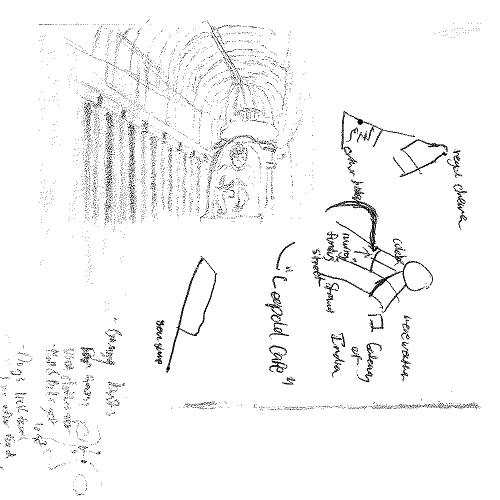
Would I sit and listen, when the prohibiter of sandals called into the echoes of a thirteen hundred year-old buddhist temple? When echoes called back to the monk and the nun who calmly sat before them? When they called out to a whole hall of exuberant tourists and brought them low and still? If so, would I sit beside them, or outside where I could munch on my almonds without the burden of atmosphere? Would I loft an improvised celestial mechanics into the last waning hour of sunlight, reconstructing the angles of sunset from half-guessed latitudes, half-remembered trigonometry, and the patiently charted ascent of the single patch of sunlight that the cold stone balcony allowed? Would I prove beyond doubt that even in this season (twenty three degrees more!) the sun must still just barely manage to shine on the boddhisatva before expiring? Would such a proof redeem the imminent twilight, and the long, ill-lit and uncertain wait for some means to return to the city?
Would we pay for trinkets? Cigarettes? Tour guides?
Biscuits? Poor decisions?
Good ones?
Of the Seven Families Dhaba, and what comes after February 6, 2013
Posted by newsthatstaysnews in Uncategorized.add a comment
A guy woke you up on the bus out of Hyderabad, told you you were in a rest stop, there wouldn’t be another, you might as well use the restroom. You objected, he countered, you sleepily complied. Only half-stirred, you saw everything sharply in the bright restaurant lights, too clear and too harsh for the convincing illusion of movement. You had had nothing but flatbread all day, so your stomach woke just a shade faster than the rest of you, and you asked for a naan.
What arrived, instead, was a tray of something hot described to you only as curry, a round metal dish maybe a meter around and thinly spread with still-toasty rice, and a spoon. A dhaba, you recalled then, is really just a word for a roadside Punjabi restaurant. You delighted.
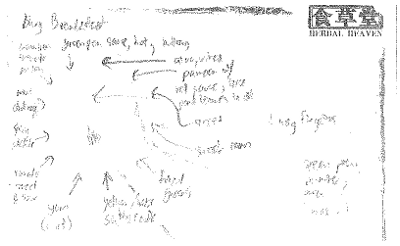 The bright noonday sun finds you walking back from the train station in Aurangabad. It’s hot, so you duck into a tall building with a sign for a restaurant. The staff tells you they’re praying, and you should come back in ten minutes. The hotel staff tells you the chairs you’re sitting on belong to them. The janitor tells you the stairwell you’re now sitting in needs to be cleaned . You walk back in to an empty restaurant, and sit down. A round metal dish appears, with chapati, and a series of metal dishes the size and shape of the plastic end caps on metal furniture. Men emerge from the kitchen bringing new names, and new colors. The names stay only long enough for you to contemplate their novelty. The little cups of sauce last just a moment longer.
There is a progression of colors, around the circle. There is a mint chutney, a spicy pickle, a sweet and sour and deeper red tomato sauce, a mashed yam with the color of an unpeeled banana , and an unaccountable freshness. Counterclockwise, a thimble-sized cake of salty canary-yellow flaky crust, like a spanakopita without spinach, or a baklava without sugar. If you proceed to eat in this direction, you next encounter fried greens in an oily sauce of a Yukon Gold sort of hue. There follows a green and yellow lamp of sweet corn, a tin of some beige and featureless local pongal, and a small bowl of eggshell-colored paneer in a russet oily sauce with the texture of duckweed. Past a little dish of aloo in some sort of reddish gravy, waits a small heap of green peas, in a hot and buttery-textured yellow sauce.
A chapati is a small pocketed round bread, like a cheap, hard grocery-store pita in shape, though not in springiness. If yours has been nimble, you may rest at this last sauce, though a little stack of cucumber, tomato and onion wait patiently beside it, like firewood on a wet november day. If you have been slow, you may find you’ve been provided with fried Okra (lady fingers, for some reason), or with another dark green sauce of potatoes and peas. If you’ve been very slow, but ask nicely, a small bowl of steamed rice may arrive to boost your efforts. If you choose to dawdle longer, a roti may make its appearance as well.
How long have you spent here? No other customers serve to measure your stay. The busboys, bringing fresh surprises, seem not to have repeated themselves. The dish was too great in circumference to be eaten in less than a minute, regardless of haste. The individual flavors have lasted only three or four bites, seven or eight, perhaps, if they’ve been replenished. The sun is still high in the sky. The local Congress party has, just now, not yet begun throwing fireworks, or shouting in unison, much less drumming. The two and a half dollars you’ll have to fish out of your pockets, once your hands are clean, provide little in the way of a guidepost. The bottle of water you’re going to want soon is still sitting in a refrigerator. Already, you find it hard to explain why the yam was so refreshing. You get up to wash your hands.

On rising in Mumbai, your friends will give you to eat. You should be warned that this will not so much break your fast as shatter it. You will begin with cake mix. You will not be clever enough to already know that microwaved cake mix does not rise, however much baking powder it bears, but hardens in place, into a biscuit. Your ignorance will be dispelled. You will be so pleased with the whole affair that you will eat the biscuit, drenched as it is in chocolate sauce. A biscuit, however, even one as big around as a twenty-foot river birch, will of course require tea. You will try, predictably and futilely, to turn it down, then to invite your hosts to join you. They will instead bring you ordinary biscuits, as tea require biscuits, and a plum cake to make you think you might at last successfully refuse something (it’ll instead go in your bag for later). You will sit, you will talk, you will wait, you will beg off, as you don’t know what the hotel checkout time is, and your things have been left unattended in an empty room. You will learn that you must at the very least stay for breakfast, and that tea and biscuits are not breakfast. Distracted, you will engage the little broken strands of vermicelli with peas and carrots which they will bring you in small glass bowls. This is a feint. When you emerge victorious, you will converse, like a well-mannered and curious person, heart warm at that moment, mind open. Only when you regroup, and reconsider your logistics, will you learn that you cannot leave without breakfast, and this has not been breakfast. The ultra-sheer dosa you have tasted from the flat, black sheet of heated iron on the street are impossible to make in a home. What you will taste instead will be a little thicker, more the consistency of an appam, almost like a pancake. It will be wonderful. You will be pleased. You will be out four dollars in late check-out fees and a dirty look from the concierge.
三人飞必有我施华洛世奇 February 6, 2013
Posted by newsthatstaysnews in Uncategorized.add a comment
It was good to travel with a friend in the Chennai airport – if you don’t put the little elastic airline tag on your bag and get it stamped, it doesn’t board the plane.
It was good to travel with a couple of NGO workers on the road to Aurangabad – no one else will ever believe me that, when the bus hit speed bumps at night, I flew so high my feet hit a metal rack a foot above the bed!
It was good to travel without a friend, because the ice cream guy on Tilak Road does a three part handshake.
It was good to travel without a friend, because I fit in a shared auto in Aurangabad, with some guys who openly pretended to each other that they spoke perfect English (dubious), and just as guilelessly to me that they spoke none at all (idem).
It was good to travel with an acquaintance on the train out of Aurangabad, because he found me a seat, and kept it somehow on a train that was full.
It was good to arrive with friends into Mumbai, because it near midnight by the time I arrived.
It was good to be far from my friend in the Thane suburbs, when the hotel discovered they needed a copy of my invitation letter to allow me to stay on a business visa. Sometimes it is better for a friend to be at your fax machine than at your side.
It was good to fly out of Mumbai with a friend, because no one else will believe me that there’s a diamond store in a domestic terminal with eleven gates.
It is good to travel without a friend, because you’re willing to put the effort in for other people to be real to you.
It is good to travel with a friend, because it’s not just a matter of effort.
Variation on a Theme by Dos Passos February 4, 2013
Posted by newsthatstaysnews in Uncategorized.add a comment
Theory: Being a pretty girl in an American bar is like being an American among strangers in India.
Prediction 1. Guys just walk up to you and hold seemingly reasonable conversations, and it’s nice. Actually, really nice. But you are always 100% aware that you are being talked to just because of what you look like.
In a restaurant in Hospet, a group of men walk up to me, hold a long conversation about their English classes, their business ambitions, where I’m from, what I’m doing. It’s initially completely and always initially rather gratifying to be able to interact so effortlessly with strangers.
Prediction 2. Being a pretty girl who goes to a bar with a prettier girl is unreasonably irritating.
By the Queen’s Bath in Hampi, a group of men walk up to my friend, whiter, blonder and bluer-eyed than I, and hold an entire conversation with him about their successes, and failures, their crusher [read: land rover], the things he likes and doesn’t about being here. Not two feet away, I am left completely alone. Somehow, in this situation, I resent the loss of undeserved attention, which is dumb enough to be funny, but not dumb enough that I don’t do it.
Prediction 3. When guys are easily replaced, it’s pretty hard to treat them like they’re not fungible, unless of course they’re not.
A guy on the train to Mumbai schemes a way for me to sit down. We talk about his travels, about India and China. A family across the way starts a conversation with me, and eventually he is completely left out, and ends up getting off the train before us. I can’t help feeling mildly ungrateful, as though my conversation were somehow meet compensation for his assistance. I can’t help feeling mildly disingenuous, for I was willing to be quite caught up in our conversation about one-child, yet in truth it is readily forgotten. I get caught up the same way with the family, at first, but conversely they prove to be quite wonderful (more on that later), and I think I continue to treat them as such.
Prediction 4. One level of misdirection is usually enough.
A man named Urylesh walks up to me, chats for twenty seconds, works his way up to my paler friend, chats with him, takes a picture with me, then with all of us, and at last one standing with my friend’s wife. We’re annoyed, but we don’t stop him. Does this picture, posted on facebook, get ‘liked’? Do his friends high-five him? What is he thinking when he calls my friend, and asks if he can talk to my friend’s wife?
Madras on Rainy Days* February 4, 2013
Posted by newsthatstaysnews in Uncategorized.add a comment
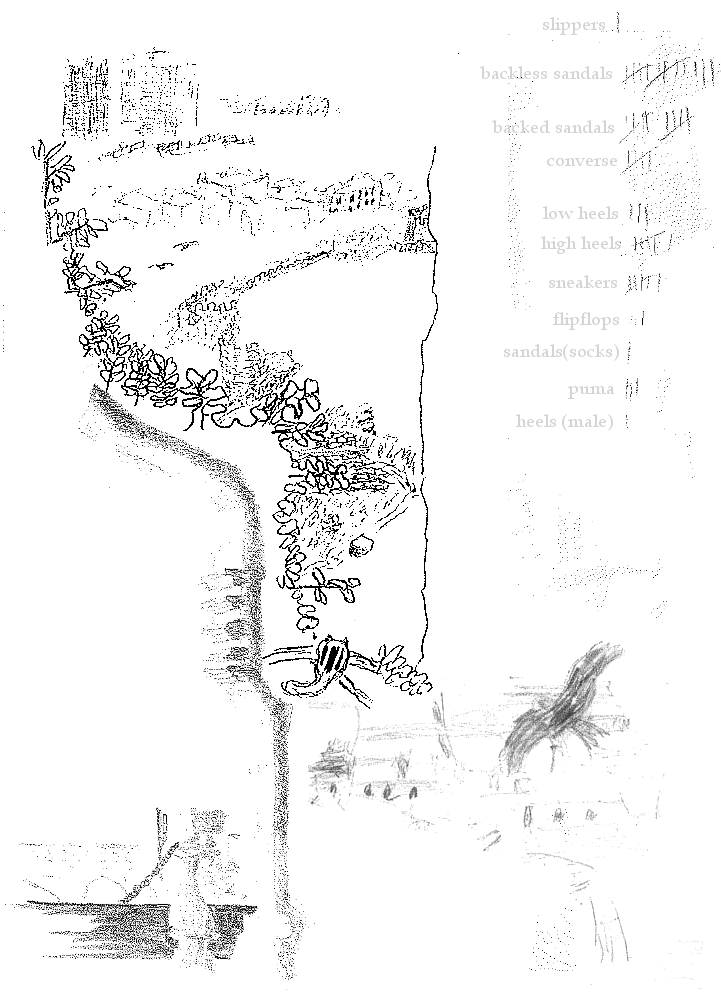
(click for full-size)
Sleep ends. I ask for Nayamapallam, am laughed at, dropped off the bus in the middle of nowhere. Perhaps, for all I know, this is a kindness. Two hundred rupees to an auto driver turns out to buy advice on which bus to take to the Mehdipatnam station (19), and which bus to connect to (142). Seven in the morning, the station, asking for bus 142, alleged to end at Golconda Fort. Bouncing back and forth in pursuit of a bus whose existence I will never confirm. A woman walks by, like they would say in the stories, who seems to be becoming a part of the street. Her makeshift clothes are almost indistinguishable from the refuse on the roadside. She drinks water out of a plastic garbage bag, like a soiled, mottled wineskin. She is hunched, wrinkled, features rougher than the asphalt she walks over. I am ashamed that I have given a smattering of coins here and there to people who claimed to be in need, but this woman never asks for money. Perhaps I should give her money regardless. Time will not bring understanding, here.
An hour later, it occurs to me to drink some ‘Balam’ tea. Tea north of Tamil Nadu has too much sugar, too much nutmeg. To a philistine, this one tastes like a pumpkin pie. A few minutes later, I think to ask for Golconda Fort. Momentarily, I board the 65g, and in a quarter of an hour, emerge by the fort, to find a breakfast of deflated puris and something like sambar near at hand. A few minutes wandering brings a stationery store, and a pencil like the teacher in Hampi had wanted. Mehlville’s distracted man always rambles to water; perhaps when I am not distracted, I wind up on a summit just as inexorably. This one has a path around the side of the fort, hot and strewn with plastic litter, but solitary. Machine guns chatter from an army base below, their dialogue first unnervingly alien, then merely incomprehensible, finally part of the landscape. In a bush, a chipmunk stirs. I sit down on a stone, try to draw him before he disappears. I get something, and he’s gone, but his front-porch remains, and I try to draw it, too. Like an unruly horse, the pen makes its own choices, and I try to live with them. People come, say something, go. They repeat, the guns repeat, slowly my meager landscape grows.
I’m told drawing teaches you to see. Maybe drawing teachers teach you to see – I don’t know. I see this bush, this wall, these far-off apartment towers, but my pen has catarcts. Eventually I stand up, walk back east, take in the eagles flight, disconcertingly dozens of meters below me. Majestic creatures. Where they soar, the pigeons flee to ground. More people pass beneath my archway, laughing, hugging, carrying on. Actually, every time an eagle even gets close, the pigeons land safely. These eagles must be getting hungry, at this rate. I think about drawing them. Perhaps the teacher was right, so I fish for my pencil, find it unsharpened, try to give it a point with a rough stone, and draw what I see. Turns out an uneven rock will only resharpen a pencil that has already known a point. I try anyway, moving back and forth to catch their majesty with my eyes, and perhaps wrestle it to the page
One of them swoops up above another and tries to pounce with its talons. Man, these guys are not much good hunting. I scribble something. The pencil resists, then lunges when I’m least expecting it. Dark lines appear, and I try to hide them. Warm sweat sits comfortably in my shirt. It’s time to make my way back down, buy a pencil sharpener, board the 66g. We pass through muslim neighborhoods, women with head scarves everywhere, burkas common if not typical. We return to Mehdipatnam. I ask an old man with bright red hair if I should get off here for Char Minar. I understand that it’s the end of the line. I sit, I wonder why it is only here that I’ve seen men cover age with bright red hair. Wonder, like the dark red color grown popular among American women, the mere act of deciding to die one’s hair conveys some vitality without needing to resort to subtlety.
Neighborhoods sweep by. A palace, it seems, for the local Congress party. Stores of every description. Restaurants, homes. Streets, avenues, alleyways. Time passes, the man gets off, I remain. Eventually we cross a river, pass what seems likely to be the Salar Jung museum, a comforting omen for my half-imagined day trip. Up the hill, writing in arabic again, banners for muslim parties, women everywhere more covered. Eventually a station. I’ve seen no tall four-masted building adrift in a rotunda, but the sun tells me that it’s behind me, and that I should change my shirt. I ignore both suggestions, find the legendary Pista House, self-proclaimed largest Haleem seller in the world. I am told lunch has yet to begin, buy a pizza crust, strike out for the Char Minar. The pizza crust is sweet, but the road is warm, the traffic light, the building tall. I make my way up an interminable spiral staircase, past a still-young woman who’s nevertheless surrendered to gravity, reach the lower gallery. Around me, a city. I walk back. The broad streets, tin roofs, the press of largely black-clad pedestrians, the riot of shop signs and satellite dishes, the preponderance of black dress on the streets all remind me of the view from above the Damascus Gate. It’s hot, so I sit down in the shade next to some middle-aged woman, offer her of my water and bread, am offered solitude in exchange. People walk back and forth. I sit, low, look at their shoes, start a tally to see what they’re wearing, my silly linear concept of modesty forever surprised to find women in burkas wearing shiny heels, even low ones. And why not? I sketch some of the archway to pass the time as shoes pass me. Children arrive, curious to see my drawing, and leave indifferent. Eventually I rise, walk to the exit, find it’s been jammed with pedestrians and isn’t moving. Laugh, because it is both surprising and expected. Sit, wait until another exit is opened and the queue to recede, recede with it.
I return to the Pista House, wait 20 minutes, learn that service will be another 20 at least, actual arrival of food unknown, perhaps unknowable. I come to terms with leaving Hyderabad without knowing what anything Hyderabadi is supposed to taste like, take off. On the way to Salar Jung, I buy a square naan. It’s sweet.
The Salar Jung is a millionaire’s collection of fancy trinkets. I hold out hope for a long time. I see the ‘veiled Rebecca’. Very skillful illusionistic marble textile, little else. Make my way to the bronzes in disappointment. Mistake; they turn out to be copied western bronzes. Around them, more anonymous copies of western marble masterpieces. Laocoon and his sons struggle to raise their hands high, so the teacher will call on them. Universally, the textile work is fantastic, the humanity absent. One, labeled only ‘Night & Day. Florence’, lets the copyists awe show through the difficulty of carving stone without genius. A piece of gratuitously sugary street bread and a one-way ticket to Aurangabad says the original’s a Michelangelo. Both remain in store for me. I thread my way back. A real Canaletto fairly beams from its place in a european painting wing. Out of nowhere, a wooden carving: Mephistopheles on one side, Margaritte on the other, so skillfully executed that as I look into the mirror before it, I cannot shake the feeling that is the glass and not the statue that is engaged in some subtle trickery. Perhaps I should linger, but the rest of the museum awaits. And then it doesn’t. There’s been a wonderful japanese scarf, ‘the thousand cranes’, clouds, patches of sunlight on the lake, trees and cranes all having somehow become indistinguishable, even as my eyes promised that every individual portion was visually interpretable. I resolve not to buy trinkets, for I have now seen the master of all trinket buyers, his jurisdiction global and his means all but limitless, and half a century later his home is become a hall of glorified knick-knacks. There is a wing of miniatures. I try, but I do not understand miniatures. I turn to go.
On the street, a man holds a door frame, with a door in it, talking to another man. By the railing are more doors. I cannot shake the certainty that this door salesman will at last open his door, and his client walk through it. I am not so foolish as to expect him to disappear when he does. Perish the thought. But, somehow my reasonable expectations of the world have had injury done to them all the same. Now, a bridge. A hospital. Alleyways strewn with trash. A small storefront BJP office, seemingly part of the community. An autorickshaw driver who has no clue where he’s going, then accidentally takes me past the place. He as bewildered as I when I tell him to stop, perhaps just as resentful. But my auto payment philosophy is strictly consequentialist. From here, another auto reaches a van which reaches a bus which reaches the outskirts of hyderabad’s HiTech city. Plate glass everywhere, bright colors, bright lights, photographs of very pale models. In time, the bus to Aurangabad comes. Sleep follows, eventually.
* I read a book with this title, hoping it would tell me about Chennai. Whole thing was set in Hyderabad, to my consternation.
Camera Obscura February 4, 2013
Posted by newsthatstaysnews in Uncategorized.add a comment
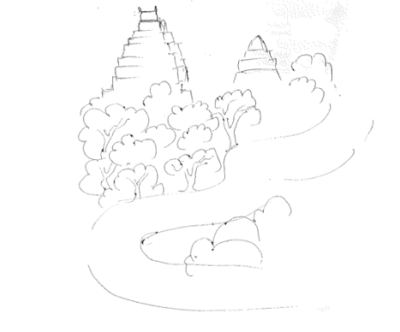
- artist’s rendering
Morning found us in the Virupaksha temple, following an elephant. He’d been let in to the temple to celebrate Makar Sankranthi, and was making his obeisances to the god. After a time, he retreated into the back of the courtyard, and disappeared from view. We watched for a moment, and then decided to hop a few pilgrim guiderails and follow him. To accept science requires a certain degree of belief in natural law: that phenomena are mostly linear, and small changes in initial conditions will at least typically come out in the wash. So, it is an article of faith for me that, despite our complete inability to find this elephant in any part of the temple, the fact that the temple had only two gates large enough for an elephant, and the intrinsic difficulty of misplacing an elephant, he really was in there somewhere.
At any rate, we proceeded into the back of the temple, where we found a dark room with a bright square of morning sunlight, cleft by a hanging, tapering shadow, tipped with little horns. Knowing that things look like the shadows they cast, I searched vainly and repeatedly for some pendant stone, with the all too familiar persistence which comes of refusing to believe the brute fact of failure or to search for its modus tollens implications, but merely assuming that there must have been some small, unnoticed mistake, and trying again. Slowly, it dawned on me that the it was not coming from inside the room at all, and that moreover the horns on the tip were tremendously familiar (see the temple Gopuram illustrated above).
At any rate, the mid-morning sun found us walking along the edge of banana fields, a young rottweiler joining us for the trip, and by turns leading the way. At the road, we left him with a few young women he seemed to know, and struck out past a colonnaded temple, past a few hundred men washing their bodies, and women washing their hair, and around the bend in the river pictured above, where we found a shady temple up in the rocks, and my friend fell asleep.
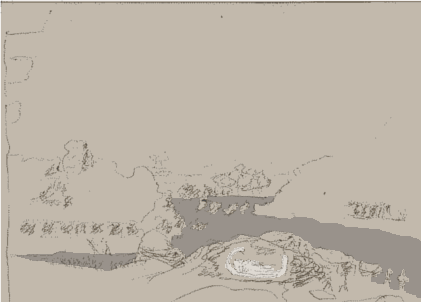
False color – original obliterated by a low resolution black and white scan
While he napped, I took in the temple, the throngs of bathers, the bend in the river, and eventually the image on the boulder in front of me, Vishnu fast asleep on Shesha. My pen was of little use in sketching the scene from my hillside temple (see above), but was also interrupted first by an adventurous little boy, and later by a few bored young men. Fortunately, it was of far more use in answering the question ‘where are you from?’, which is hard enough on my best days, and harder still when my language collides with the sheer irrelevance of knowing where countries with only two crore of inhabitants are to be found.
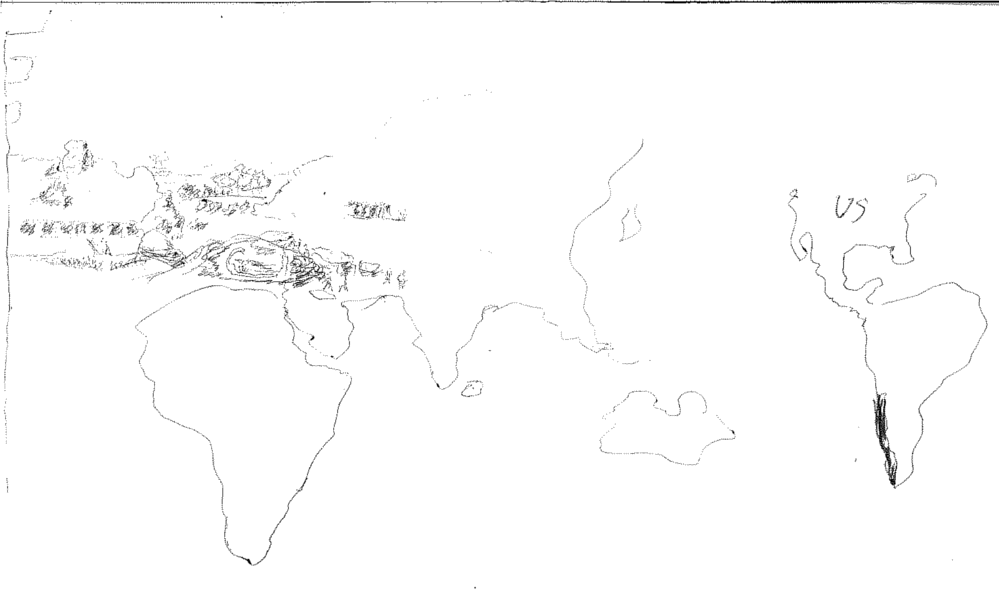
Eventually, my friend got up, and we made our way further along the river, past the ruins of an immense causeway, up along a gently sloping smooth stone expanse. There was a coconut-laden autorickshaw trying to push-start up this stone, and I joined a group of young men trying to get it up to speed along the weather-beaten stone. Scrabbling for traction on the smooth stone, hoping that the driver would hit the brakes if he started to slip backwards, brought a perversely pleasant mixture of pride, dull fear, and irritation. This is perhaps not how the wise take their leisure.

artist’s rendering
From there, we made our way up a hillside, piling our backpacks as a step-ladder to negotiate the last smooth stone face, and taking in the improbable boulders, scatted across the hilltop. My friend set up in the shade of one of them to write a few letters, and I in the bright sunlight to try to capture the incredible plain below. I suppose it’s the glaciers that leave these outcroppings far above the surrounding plains, but the combination of the land and the river below, the hills in the distance, and the scattered temples the Vijanagara empire had left behind, some ruined and some still in use, was majestic. To capture the burning sun, the magnificent view, and the moment of deciding what to sunburn, as your clothes can’t cover everything, might be beyond anyone’s capacity to sketch. Perhaps if you’ve felt it (the great wall is recommended for this purpose, but any impromptu ridge-hike in summer would probably do), you will remember. As for my sketch, I got as far as this:
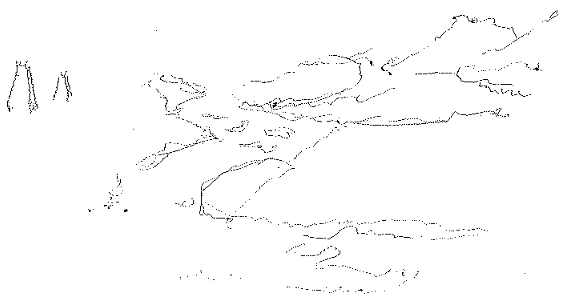
When we saw a few men and a boy making their way up the rocks towards us. A pair of central London used-clothing dealers would later suggest to me that these low hills are in fact filled with brigands, but as it was we helped what seemed to be a family up the last purchaseless slope, and they mostly settled in to talk to my friend about his experience of America, while one, a drawing teacher by trade, set out show me how to draw the scene (see first drawing), before eventually realizing the scale of what I wanted to do, and the fact that I didn’t have a pencil, and adopting an air of good-natured resignation. Eventually, we made our way back down the slope together, and the family gave us first sweet pancakes like flattened PBJ, then puffed rice, and finally dry roti with some sort of curry powder for flavor and water to mix it with. Immensely satisfied, we parted ways, they seemingly headed back home, we to some world heritage temple which we were by then too tired from walking and climbing in full sunlight for hours to care too much about one way or another.
They say Hampi has a meditative and tranquil air about it, the deserted capital of a vanished empire both a monument of human potential, and memento mori. They evidently don’t happen to choose to be there for the Makar Sankranthi, when (whether or not one believes the estimate that the city once again holds the half million souls it once accustomed) it teems with bathers, hair washers and temple-visitors: families, groups of men on vacation, american tourist delegations and an airport-style oversized electric golf-cart full of catholic nuns.
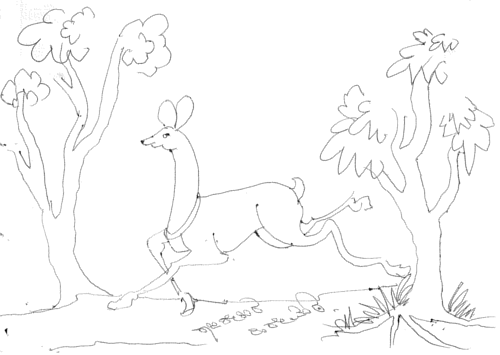
Perhaps, in another lifetime, I would sit on the top of that hill for hours, drink in the hills, the meandering river, the scores of stone buildings laid down twenty generations since. Perhaps the wind and the sun would be like the hills above Termas de Cauquenes, or the Wadi Qelt, never too much further than the closing of my eyes. But, I have another image in its place, no less sharp, no less distinct, and autographed to boot!
[ɣəˈzɛləɣɦɛit] February 4, 2013
Posted by newsthatstaysnews in Uncategorized.add a comment
Gezellig can also be used as an exclamation, which can either carry the meanings described above or be used sarcastically or ironically. [wikipedia]
The first obvious thing about Bangalore was the clean, plate glass, and the small child with mirror shades and a yellow shirt that said “Homework is Over” slipping into the remarkably clean bathroom. Then, there was the vast, gleaming, plate glass lobby, a hundred meters in length, with a Coffee Day (‘ a lot can happen over coffee’) on one end, and another Coffee Day (‘a lot can happen over coffee’) on the other. We strode out to the improbably well-labeled public bus terminal, past the #7 to MGR, and onto our shiny, new, air conditioned green #9 to Gandhi Nagar. The highway before us was improbably smooth, and disorientingly fast. The role of space-filling two-wheelers in grinding traffic to a halt was as neatly demonstrated by their absence from the airport road, in which freedom a well-maintained bus can make sixty kilometers per hour, as by their presence in the market, which we crossed on foot and where we once spent three minutes immured in a single crystallized intersection.
After taking our lunch with and our leave of B—, we traipsed through a few bookstores into the large and parti coloured Cubbon park. In the garbage-strewn section, we found a group of small children with a cricked bat, who asked for water. In the tree-filled southeast entrance, a throng listening to some untranslated vitriol, flowing from the back of a 5-ton truck covered in Kannada flags, and soaking into the earth near a gaggle of musicians, standing by, perhaps, to replace it in due time. In the green, grassy terraces near the state courthouse, a heavy scattering of seated lovers, packed near to what romantic degeneracy pressure is likely to support in the absence of any public spectacle. Certainly, one would hope that the Pauli exclusion principle remains operative in this sort of situation…
We emerged, and made our way past a park of 15m tall bamboo, wide as my upper arm and sheltering an unexplained statue of a stegosaurus, to a government museum with an intriguing collection of sculpture and a ‘large breasted Durga’ according to the guide book, and no open doors whatever according to reality. Foiled, we struck out across the morass of rich people’s shopping opportunities that is one corner of Bangalore, and to the bar and branded-clothing district that is a second. Time rolled away as we searched for the Hotel Bangalore Gate. We can afford to stay in pretty nice places, and since we can’t afford not to know where we’re going, we often do (by my standards, anyway). This one is marked out by a fair-sized archway with a 1m tall illuminated sign which was, for all practical purposes, simply not there when we walked past, wearily misinterpreting a policeman’s directions and wandering with increasing alarm into side streets until at last we realized that we’d either gone the wrong way, or were anyway going to need to find a different hotel.
Nightfall found my friend feverishly napping, and me acrimoniously refusing the State Bank of India security guard’s instructions to leave the air-conditioned ATM premises. Pro tip: ATMs in India will swallow the cash back up if you don’t take it immediately. For comic effect, you can try calling the posted phone numbers in search of relief. A motorcycle ride, two (out of an eventual three) visits to the self-service multi-cuisine corner restaurant, and much conversation with the Concierge later, my bank was (allegedly) aware of the mixup, my friend sound asleep with idly and paracetamol in his stomach, and I with a long-sleeved shirt and a pair of dubious ‘milaan’ black leather shoes in search of a club called ‘Opus’. My first attempt featured a detour down a series of dark and unlabeled streets in the north of Gandhi Nagar, and persuaded me to hire an autorickshaw for the second. Repeatedly unable to explain which ‘office’ I wanted, I eventually persuaded an auto driver to just drive straight down Palace road for 2 km. At the end, he suddenly realized what I was looking for, unwound a few blocks of one way streets blocked willy-nilly with cement dividers, and deposited me in front of an honest-to-goodness Rihanna-blaring club.
How one runs a salsa social on the second floor of such a building, even having witnessed it, I could not explain. Approaching the building, I was sure I’d got the wrong directions. Leaving it, I was suitably impressed by a fair sized, pretty skillful contingent, if a bit sad that even here, in a city which has been conspicuously richer than Chennai for some time, every other woman was, to judge from the number of men, presumably staying safe at home to avoid the risks of a solitary return home at 10 PM. In retrospect, perhaps it’s only that Bangalore is larger, and the salsa crowd that night smaller, and therefore, compared to the small, rich, IT-affiliated and thoroughly westernized Chennai salsa scene, yet more dramatically privileged and unrepresentative of what is ordinary even in an upper-middle-class existence.
So what did Bangalore feel like? The market, an incredible emulsion of old women tugging sharply on their vegetable sacks to dump a few more potatoes before their customers, and young men pushing 3-meter carts; the whole colloidal mess somehow allowing slightly-more-than-Brownian motion in the direction of travel. The advertisement on the street for 18-again: poignant if you know this song, until you realize that it’s selling what it describes as a ‘vaginal rejuvenation cream.’ The police academy with its murals of cheetahs, antelopes, and men with AK’s kicking down a door. The sublime scene, if one could reduce oneself to a camera, of an empty lot a few blocks west of the market, the open space piled with dust and rubble, the three- and four-story buildings in dull and slightly different tones of dusty, moldering cement and plaster, the people standing in windows, looking out, the bright, clean saris drying on clotheslines. The huddled young men in Gandhi Nagar at night, staring at a smart phone.
So what did Bangalore feel like? An extended and not wholly unserviceable anaphora, not adding up to much.
Thoughts on 9 days on the road January 22, 2013
Posted by newsthatstaysnews in Uncategorized.add a comment
There is a case of a party of miners, buried and shut off from every possibility of knowing the passage of day or night, who told their rescuers that they estimated the time they had spent in darkness, flickering between hope and fear, to be some three days. It had actually been ten. Their high state of suspense might, one would think, have made the time seem longer to them than it actually was, whereas it shrank to less than a third of its objective length. It would appear, then, that under conditions of bewilderment man is likely to under- rather than over-estimate time.
(The Magic Mountain, Thomas Mann)
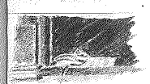
I’ll start writing soon. In the meantime, here’s a little guy I found perched on the window sill of a few-century old Jain cave temple at Ellora, trying his best to nibble away at an empty bag of chips.
How to Draw a Kolam January 5, 2013
Posted by newsthatstaysnews in Uncategorized.add a comment
In the morning, in Madurai, I found myself standing on the sidewalk across the street from the ‘Dora Shoppe’, squinting to read the subtitle on the street sign. ‘Across from the Jesus Saves Tower’. What? I whirled around and saw that I indeed stood before the gaze of an architecturally nondescript 3 story lavender building helpfully labeled ‘Jesus Saves Tower’.
An affluent brahmin man in his early thirties with gelled hair and a cultured indifference to his job as a tour guide told us that Saint Thomas landed in Kerala in 52 AD, and that Santhome here in Chennai was not saint-home but san-thom. And that Christianity had very old roots here, old enough that when the portuguese landed, somebody told them that there’d been a christian buried (and murdered) here some fourteen centuries earlier, they dug up a body, sent it to italy for verification, and kept just a fragment of a knuckle bone (from the right hand which touched the wounds of the resurrected Christ, no less) to build a cathedral around. In the crypt was the fragment, along with an amplifier for an electric guitar and images of John Paul II’s visit to one of only three basilicas built upon the relic of an apostle (helpfully pointed out by a sign). This makes me wonder again, at the idea that keeping pieces of history will somehow bring us closer to the forces that shaped it. There’s a museum in Madurai, which I pointedly did not visit, that has the blood-stained dhoti Ghandi wore on the day he was shot.
Perhaps it is not less reasonable than to believe that we do more than concentrate our own focus when we genuflect, or that we do more than celebrate when we draw a Kolam. I’ve seen them on the ground in front of the homes between my workplace and the B&B where I stay, every day fresh and curiously symmetrical designs traced out on the dirt in white chalk, though I could hardly fathom how one writes with chalk on humid earth. I saw them in color, for the first time, in Madurai, after I wandered out onto the road that borders the vaigai river, taking it for another in the absence of any large body of moving water. In the fields away from the city was a little pond, covered in plants, with flowers in greater and greater density as one’s eyes swept right, until at last they converged on a pile of plastic garbage bags. And so, my eyes strayed in to the homes I was walking past, and to the ground in front of them, where I saw something like this, for the first time:

puttu thoppu main road, december 28
I saw one again in Chidambaram, where a woman splashed a bucket of water out onto the earth with her hand, swept it with a bundle of twigs something like a whisk, and then set to work sprinkling the dust upon the ground. The whisk, I would see again time after time, in the early morning, the women employed by the city to clean the streets bent over almost ninety degrees to clear the road with them. Broomhandles, it turns out, are a delicious luxury – one that the metropolitan government has seen fit to economize on. The Kolam, I would next see with a whole family gathered around it, spelling out ‘Happy New Year’ at 2 am in Pondicherry, as I made my way back to my hostel, no longer speaking in Chinese. And, again, after a night beneath the full moon on a wicker bench atop my hostel had cleared the last of the Lord & Master from my eyes, as I walked towards the shore, and a half a dozen women wandered out of their homes to draw them. Among them, I found one middle-aged woman drawing a grid of points, and looking in a small booklet of designs, much like a pattern book for crochet.
Past the fork, where those who live in palm thatched huts turn left, and tourists like me turn right, the street filled with groups of people, waiting for the year’s first sun. There’s just a nip of cold at 4:30 in the morning in Pondicherry, of the sort that one might dispel a warm thought, if one were backpacking from New England, or a monkey hat (full face woolen mask) if one were commuting to work on a motorcycle. By 6, though, it’s warm enough for anyone, and the clouds over the Bay of Bengal are rimmed with light, for the first time. Around me, groups came and went. A group of kids made their way down the rocks, smashing glass bottles and feeling full of themselves. I asked a local for a pen (apparently a stereoisomer of a traditional backpacker bugbear), and tried to make sense of the gray scene as the morning star crept gradually into the sky, bringing a golden blue into the waves, and then green, and then white, and then disappearing into the glow about the clouds, as first the cirrus, and then an arch like a discarded crab’s leg, and then the rim of the whole cloud wall lit with red, and the backlit haze sprang up above it, so that when the sun finally stepped out from the wall to scatter gold across the waves, it seemed impossibly to be standing in front of, rather than behind, what was left of the dust and grime and fog. Then I picked up dos Passos, and carried him off past the train station to Baker Street, confusingly on Rue de Bussy, even more confusingly the same as Lal Bahadur Shastri Road, where a quarter to eight found a steaming fresh baguette in my hand.
This seems like as good a point as any to point out that Pondicherry is the only place I know where a quarter of an hour at the american minimum wage will buy you either a fresh baguette or fresh idly. And, I know that this is not manna from heaven, but the product of the staggering wage disparity between the US and India. But, for a moment, for a traveler, it is a nice thing. As for Baker Street, I eventually came to have opinions on their quiche (good), their tea (good), some odd pastry that turned out to be a ham-and-cheese sandwich with the layers out of order (good), their bathroom (convenient), their location (excellent), their hours (perfect), and their chairs (comfortable). dos Passos I’m a little more conflicted about. If anything, he has that gift of writing which is to make it seem like anyone could, if they tried really hard, write something that would be worth reading. Maybe just a small thing. Then too, the sailors in the indies, and the useless ivy ambulancemen in the north of Italy, and the outraged labor organizers, and the bored americans making their way through a microcosm of the real paris around them, make good company for a backpacker, as he waits for the train, or whiles away the noontime heat with an imported swiss ginger beer (?) in the shade of “Le Cafe” by the sea.
[pro tip: ¬((∃ b: (b ∈ pondy∧ b ∈ baguettes ∧ b ∈ tasty-things)) ∧ (x ∈ pondy∧ x ∈ baguettes) ⇒ x ∈ tasty-things)]
His women are weak creatures though, unable to get what they want, or say what they believe most of time, possibly unable to pass the Bechdel test. And yet, like his men, they are weak in so very familiarly human ways that I am tempted to forgive dos Passos, and anyway certain to keep reading. I have long bus-rides ahead, with little but him and Bhagwati to keep me company. And yet, I look forward to them. When the Pondy Express gets into Chennai Egmore, I return to the speleothems of the life I lead, the objects of my striving. On the road, I stare at the rosetta stone of a bus terminal, trying to memorize தஞ்சாவூர் orசிதம்பரம் so I can recognize them in a bus window. I stare a the ceiling fan of my little hostel room after an unwise after-dinner chaser of masala chai, and I think without anything around me to draw me away. I stare at the rail bridge, the boats, and the gorgeous பிச்சாவரம் river on the way into Chidambaram, where a few spots of repair work have narrowed the bridge to one lane, and a single policeman vainly tries to manage traffic across the bridge several hundred meters long. I stare at the 1/2 a kilometer of backed up traffic waiting to get onto the bridge, awed that traffic can cross the bridge at all without the 2 points of good old-fashioned command and control that I’d have predicted. Stare at the motorcycles that ignore even what transit directions exist, and roar back and forth down a single sidewalk. Stare at the Dreamz Inn and the Wheelzs shop, and think ‘my cousin Jeff would love this.’
All the road asks is that you know that the C3, C4, 3 and 3A buses will take you to the new bus stand in Madurai, what you want from the next 15 minutes of your life, and that a 500 rupee note is actually only worth about 450 rupees, ’cause you’ll have to buy something expensive to change it. In return, all you’ll ever get is a bus ticket, a masala chai, a fresh paratha, and the peace of mind to remember, as you copy a kolam on a sweat-stained notebook page, that it only brings good fortune on the ground before your own home.
 News That Stays News
