“Oh how quickly passeth the glory of the world away!” March 18, 2013
Posted by newsthatstaysnews in Uncategorized.add a comment
I felt a bit childish, to have reached Punjab, a thousand miles from anything like home, and in all probability a singular opportunity, and to spend my time in simply sleeping, reading, and at times wading across the sidewalkless bridge, thinking, quite against my will, “sikh transit gloria mundi”. At rest, I did not feel weariness, but self reflection is not easy for me.
I was disappointed when I chose not venture to Himachal Pradesh. It took perhaps a day and a half afterward before I sought and failed to deny for the last time the necessary consequences of taking even a broken fever to a day or two of bitter cold, or still-loose bowels to six hours of bumpy, winding roads. It took perhaps another hour to make peace with a decision to which I at last conceded no alternative. It was a little better when I finally returned to my hotel room from a walk, lay down on a soft enough bed, and slept.
In time, I came to be feel curiously happy, to believe that I was exercising what virtue belonged to my situation. I found a tailor to cut and hem a pair of pants, that I might again wear something unsoiled by sickness. While he worked, I drank lemon coriander soup and sat on a cement slab in which were sunk the six-inch stainless serif words ‘NO EXIT’. I found the “Booklover’s Retreat”, where practical sorcery and books of chemistry experiments sit one atop the other, and a man who has spent the last half century selling books observed that “Bertrand Russell was a great man, but they do not read him so much these days”. I found the Crystal restaurant, which sold me cardboard boxes with plastic bags of rice and hot lemon coriander soup inside them to accompany Russell in my room.
Through a narrow alleyway, I found the Jallianwala Bagh in which to read Russell. A peaceful walled garden amidst a sea of five-story apartments, with barbed wire to keep one off the grass, waste bins to leave litter, and painted labels to make the bullet holes in the walls easier to see. In the words of the well known Indian independence activist Winston Churchill:
The crowd was unarmed, except with bludgeons. It was not attacking anybody or anything. It was holding a seditious meeting. When fire had been opened upon it to disperse it, it tried to run away. Pinned up in a narrow place considerably smaller than Trafalgar Square, with hardly any exits, and packed together so that one bullet would drive through three or four bodies, the people ran madly this way and the other. When fire was directed upon the centre, they ran to the sides. The fire was then directed upon the sides. Many threw themselves down on the ground, and the fire was then directed on the ground. This continued for 8 or 10 minutes, and it stopped only when the ammunition had reached the point of exhaustion.
At the end of that road, I found the golden temple itself, around which to think about what I’d read. Some things are still magnificent even if you are led to expect them. At the main gate, one begins to hear the chanting, and then suddenly, past the white stone pillars, the temple itself: a warm golden haze in the rippling black waters between the bright reflections of sodium vapor lights. It speaks to the inexcusable poverty of my memory and imagination that I can only compare the style of metalwork of the unreflected temple to a gilded cigar case, in form like some silver tray that one’s rich aunt might have lying about the house. Looking outward, the whole perimeter in white, lit by its own patchwork of mercury vapor. To the south, two great watchtowers, partially rebuilt, and an incongruous water tower, same. It’s easy to forget that thirty years ago, the whole complex was filled with armed insurgents, then with soldiers, and finally with death. That the army used artillery against the great white building to the left. That the assassins of Indira Gandhi are still honored there every year. Today though, it is peaceful, and full even at 8PM on a Wednesday. I sat by the water and thoughtabout sin as lèse-majesté against God, which I like as a moral rhetoric, but I guess I don’t really believe in. And vice as a state of moral disorder in a person which I don’t have a good vocabulary for, but I guess I do believe in.
Beliefs have a dreadful tendency to imply one another. I thought about Xenophanes for some reason, and thence about a tiger’s virtues, among which mercy is nowhere to be found. I felt bound to try to explain why it might yet turn up among a human’s virtues; I seem to remember that Aristotle does this, but don’t seem to have been impressed enough with the details to commit them to memory.

Angelus Novus, Paul Klee, 1920
I would like to believe, too, that virtue can be stable in the aggregate. The clever and the wise have yet to convince each other from first principles that the basic rules by which we understand our universe allow such a condition. And as no traveler has returned from such a land to publish in Nature, science has for now provided little hope of this.
I have long been puzzled by the simple rules of Chess, and myriad interesting possibilities they are found to contain, among them that my father and I might play it contentedly by the fire. I am no subtle metaphysician to say in what sense those possibilities come to exist when the rules are set out, or how come they are good whereas the rules of the card game ‘Ass,’ which I’d learned not long before, produce a long and arbitrary round of elimination and then -after a brief period in which it was advantageous to have kept count of the suits- promptly conclude.
To me, ‘Progress’ is the hope that basic decency between thinking creatures may in that same sense result from the rules of the universe, and do so more and more frequently as individual capabilities increase. I believe that God intended something with these rules. What is more improbable and more arrogant is to think that we may be a part of it.
At any rate, I stood and queued up to walk into the golden temple itself. From within, I could see that the riveting was not so perfect, and the ceiling fans were -painted bronze to blend in. That three men were chanting over the book, seemingly the chanting which I could hear outside. It is beautiful without being perfect, so that it doesn’t matter if the gold is only a veneer. I liked that the two flights of marble steps to the rooftop are narrow, and not overly regular, and the sense that there was no need for them to be. On the way out, there was a sugary dough for those who had passed through the temple. I did not eat it, and as I passed out the main gate, the chanting faded away behind me.
On the whole, I confess that I enjoy the torches-and-incense aspect of houses of worship, and the sense of the sublime that it creates independently of the reflective action of reason. I recognize that the conditions to create this feeling can be understood, and cynically manipulated to create authority. And yet, I still believe that the sense of the sublime helps us understand truths about the world beyond whatever directly inspires it. I feel more than a little childish, believing that without any reason at all.
“Whilst they lived they seemed to be somewhat, but now no one speaks of them” March 18, 2013
Posted by newsthatstaysnews in Uncategorized.add a comment
Ala-ud-din Khilji is the sort one has to respect, after a certain fashion. Though he reigned in Delhi, his armies ranged as far afield as Madurai. Though Delhi was sacked under his rule, in the years after the death of Kublai Khan Khilji’s generals defeated the Chagatai Mongols not once but four separate times. Such a man saw the century-old Qutb minar, and decided that he would do build a tower twice its size. At his death, it was thirty meters across, and twenty high. Four years later, his dynasty was gone, replaced by his general Ghiyas ud-Din Tughluq. No one ever touched the Alai Minar again.

I cannot see a pile of rubble, in the clear outline of a fluted column of impossible proportions, and not think of Shelley’s poem. As it turns out, in those times buildings were always built by piling the rubble of older buildings and fixing them with cement, and only afterwards neatly cutting stone for the facade. This is interesting, but cannot combat the feeling that an enchanter had begun to raise the tower, and then all that he had built had fallen from the air into a pool of cement, and been left floating in an invisible mold, like bits of chicken do in a clear plastic bag of lemon coriander soup. If that last image is not especially evocative for you, there is still the sheer span of time for which this project has remained abandoned. The engraving below is from within a generation of the British conquest of Delhi from the Mughals, about two hundred years after Shah Jahan built the Taj Mahal, and three hundred years after the Mughals themselves took Delhi from the Lodi sultans. At this point, I begin to lose track, for by then the Alai Minar had stood barren already for three dynasties and nine generations, and yet when Ala-ud-Din first set out to build it, the original construction of the Qutb Minar had already passed out of living memory.
The Qutb Minar is by turns impressive and just old. The original design would have pleased Gaudi: three stories of a vast and tapered fluted column, the flutes first angled sandstone, then round, then alternating cylindrical and angled, and always maintained in alignment. On account of the natural disasters of the better part of a millenium, the higher stories are no longer related: the fourth floor is completely smooth and faced in marble. From near the base, the whole thing feels a bit like forced perspective, as though the someone had been trying to make the tower look even taller than it really was. The inscriptions and the red sandstone walls are a bit worn, and in truth perhaps no longer so very impressive. The balconies seem, at first, to have been recently hung with a metal screen to keep pieces from falling off and hitting anyone on the ground. Then again, one realizes rather suddenly, the pendant metal mesh is in fact an effect just an effect produced by the stone carvers of some long ago time.

Ruins of Delhi from Adam Khan’s Tomb
Ayaz Basrai is the kind of guy you have to respect. Everybody’s sure that electric doors are cool. Best Buy thinks electric doors that slide open when you stand in front of them are cool. Ayaz knows that doors that slide open when you press a button on the wall, are way cool. In the bathrooms of the club he designed, on the second to last floor of the crescent mall, are toilets that genuinely feel like they might be recycled space pods. The club itself is a curving and organic mix of light and shadow that I don’t expect outside the fantasies of madmen, and perhaps the City Museum. Perhaps it should not be surprising that the crowd there is classy. It’s one of the few places I’ve walked into willingly while I’ve been here and simply felt completely awkward. Sometimes, I rely on foreignness to get through situations that I do not or cannot make sense of. In fairness, I should concede that the scene was colorful, the gender ratio nearly balanced, and that my friend later reckoned that there was one song that had gone well, even if I’d shown no sign of noticing. Yet, I’d somehow got that feeling -uncommon even for a dilettante- as if everyone I danced with was consistently off by one beat. That being crazy, I just called it a night.

This is real
Ayaz handiwork in the restaurant on the rooftop itself, however, was even more incredible. I ordered lamb on a skewer for old time’s sake, but it was not like old times. Perhaps I should have expected something different when a little bowl of parsley butter turned up with a few warm rolls. Perhaps, in truth, I should have expected something different when I saw the screens between the sections, like the whitewashed sections of some gargantuan butterfly’s wings, shot through with triangular holes. Perhaps when I took my seat, intensively curved and yet quite solid, and a little as though Botero had gotten high with Dali, and decided to paint the hilt of a giant’s rapier, left carelessly thrust into the ground. When it did arrive, the lamb was indeed on skewers, but spread lightly with mint, laid out on a beautiful walnut-stained wooden plate, and tender enough to savor the feeling as the pieces came apart. Around it on the plate lay a salad of fine texture, the bell peppers cut smaller than the corn they mixed with, and the rice of a stout but small grain I’ve not seen before or since, and didn’t think to inquire about. Even the whiskey sauce, despite what the name evokes, was superb. It was the sort of meal one should have eaten with eyes closed, but that beneath the serenely curving crescent of lintels, and between the implacable white cylinders that held them, one could see the Qutb minar, lit against the night.
In truth, somewhere around a half millenium after it was built, the world began to fill with other tall, tapered red towers, horizontally divided at regular intervals. And for a person who has seen factory chimneys, the feeling of knowing what one is looking at is quite powerful indeed. But the tower was finished, for the first time, before Thomas Aquinas took orders, and that’s the sort of thing that demands some respect.
“O if they would give that diligence to the rooting out of vice… which they give unto vain questionings” March 18, 2013
Posted by newsthatstaysnews in Uncategorized.add a comment
Pakakala II is home to an aro plant. Like most aro plants, it had a pump to bring up groundwater, a storage tank, and perhaps some calcium compound to promote the precipitation or aggregation. It’s also got this big electrical thing. But, no one we spoke to, within an hour and a half of Pakakala found that remarkable. The people filling their twenty liter tanks from the faucets beneath the black stone plaque (this aro plant dedicated by so and so on such and such a date), didn’t seem to find that remarkable. The right to do that between seven and eight every morning for a month cost Rs. 80 instead of Rs. 75, but that seemed fair in the grand scheme of things. That the right extended to filling water tanks in the evening if the faucets were available, but not to knowing when the faucets would be available, fazed no one. The name of the company that had installed the beautiful reverse-osmosis water purifier did not ring a bell.
It was beautiful if you knew what you were looking at, which the operator and the operator’s son and I and my driver and my translator and, so far as we could discern, no one else did. Provides clean water, probably prevents ailments for scores of families in Pakakala II, though not in Pakakala III because people don’t seem to be aware of any reason to travel that far to get the water.
Maybe that’s too cynical. Water purifier or not, I was sick on the way out to Pakakala, three and a half hours from the nearest large city. And, I couldn’t ask more questions while I was there because I would be sick on the way back, too. After all, these guys were on businessweek’s list of top american [sic] social entrepreneurs of 2012. They were on the MIT tech review’s 50 disruptive companies in the same year, for trying [sic] to make money on telemedicine clinics in rural Punjab. Even before that, before their CEO moved to Delhi, when he was still dreaming of providing pre and postnatal care in Andra Pradesh, they had been recognized by a joint venture of USAID and the Bill and Melinda Gates foundation.
It’s hard to be appreciate such things on a queasy stomach. An experience that I’m glad one or two hundred people in Pakakala II have less often, right now.
“Where now are all those masters and teachers?” March 18, 2013
Posted by newsthatstaysnews in Uncategorized.add a comment
I arrived late at the Taj Mahal. Soldiers with machine guns conferred on what to do in a language I could not understand. They pointed me to a small bus. I got on the bus, two officers in the far front, one soldier before me, one sitting across the aisle, both with worn, dirty wooden rifles. The bus took off.
I did not feel my own fear, then, but I felt the fear of others. By the thousands, my people stepped into cars with men with guns. Young men, their weapons used and their consciences still fresh. My godmother’s sister walked out of that stadium, recrossed the threshold of the disappeared. From the tourist-friendly, modern heart of a democratic country to whom I was enemy by neither action, ideology, nor descent, I still felt the echo.
We pulled into some sort of processing station. I left everything. My bag. My cell phone. My pen. I got back into another van with two more young men, two more rifles. We drove away.
“And all our power of sight is not without some darkness” March 18, 2013
Posted by newsthatstaysnews in Uncategorized.add a comment
I woke early on the other side of the tracks, drank the local Chai, spiced like Mumbai, but not as sweet. Slept intermittently in a chair in an AC car of the morning express to Agra, and listened with some sympathy to a pleasant young hedge fund secretary who’d had the frightfully poor judgment to heed directions from a man standing by the railway station metal detectors. The better part of an hour and dozens of dollars later of course, she’d gotten out of an Agra-bound cab and returned to the train station. We hired an auto to the Taj, which I left halfway to join the queue at the Indian Archaeological Survey for tickets to a night-viewing. I stood and chatted with an older gentleman who turned out to be an elector with an eponymous square near cambridge city hall, accorded to meet him again at 9:30 the next evening by the east gate of the Taj, and procured a return ticket to Delhi. A few hours of linear algebra later, a bag of almonds, a Mughal tomb, and a broken-down auto, I arrived near the Nirvana hostel. A kilometer south from the main road, I made a right into the parivaran complex, a vast and closely-spaced apartment complex. The streets were like the gorges of small mountain streams whose walls obscure the sky, but with the peculiar tessellating anonymity of a large urban complex. I backtracked, and asked a cybercafe operator where to find Nirvana, earning myself a smirk and directions through a nearby gate. On the other side were piles of construction supplies, and a single incongruous built-up street, like the facade for an old western. I would have left now in another country where I didn’t belong, didn’t know my way around. A man walked into the street, and I asked him about Nirvana. I didn’t understand him, nor he me. Eventually he made a phone call, and disappeared into a building. On his return, key in hand, he motioned me to a stairwell in the back of an open but unlit garage.
But for the cybercafe operator, the hundred hostelworld reviews, the knowledge that I was in the middle of a relatively posh area of the city, and most especially the peculiar sense of security I have always had in India, I would not have followed him up the stairs. On the first floor, he opened a door with someone’s name on it, and indicated the interior of a largely empty apartment. At this point, I recalled my friend’s dictum: it’s always fine until it’s not. But, were anything going wrong, it would clearly have been too late to leave now. I walked in. The apartment had maybe a half dozen office chairs in it, and a room with a queen sized box spring-less bed, Disney princesses on the wall, and a sticker of Dora the explorer. I cannot recall what I said to the man as I walked away, but I thanked the cybercafe operator heartily for not telling me that Nirvana did not exist. It pays not to believe anything anyone in the tourism industry says along the lines of “you cannot ____” or “____ does not exist.” But then, every once in a while, it pays to believe.
I ended up staying with some employees of a friend of a friend of mine, in a room a little too big for a king-size mattress, attached to a generous bathroom and a 2 x 2 pantry, on the fifth floor of a building. Off the road straight, left, right, left, past the snack stand, right, through the narrow bit, right, left, left. In the morning when they woke, they said they were tired as they’d stayed up all night talking. In the morning, I read about groups, and they cuddled in their sleep, and sometimes one or another moaned softly. In the morning, after one of them helped me make my way back to the main road, I tossed out some special orthopedic trainers that were destroying my knees, bought some brand new reeboks, and walked out into the world.
In the evening, I was surprised to learn that “you can stay in a mattress on his floor, he’s a bachelor, it doesn’t matter,” meant “you can share a bed with him and his flatmate.” I was surprised by what I have been told is the intensity of Indian hospitality, and a notably energetic interest in my life, and my doings, and sharing his own. In the evening, I was surprised by what I’m told is the intimacy that American society simply doesn’t allow between male strangers: to lie on a bed, and stare at one, and to talk to him. I was surprised to be asked, as a result of a misunderstanding, “how much did they pay you to be here?”
In the evening, a bit like a young orthodox Jewish schoolboy, I thanked God that I wasn’t a woman. I asked myself a couple of unaccustomed questions, and decided that the answer was that the only choice I had was when to sleep. In the evening, I decided that that moment was straight away, and so I did.
* * *
Two hundred kilometers and twenty four hours away, a young frenchwoman came to the same conclusion. The hostel employees had had a devil of a time convincing her to let a young man who’d arrived maybe an hour short of midnight share her heretofore empty dorm room. When he walked in and spoke to her, she didn’t reply; just lay with her back to him in her sleeping bag and pretended to be asleep. When he walked into the bathroom, she rustled around, put more clothes on. And when he came back out, she was silent again, still. Someone had taught her a good lesson: despite the nonexistent legal protection of women, public officials referring to sexual harassment as ‘eve-teasing’, despite being forever exposed, obvious, the strange epitome of the desire for light skin, it’s really the other westerners you should probably keep an eye out for.
This particular westerner lay down and shivered. Suddenly, he understood why it was so cold. Why the seeing Taj Mahal, perhaps the world’s greatest monument to love aglow in early evening moonlight, &c., had mostly impressed upon him how much his knees hurt. He got up, took some sort of greenish-blue translucent pills, put on a thick winter coat, and asked her if she’d feel better if he left the door bolted or unbolted. For a moment, he was smug, for it is an excellence of a traveler to ask precisely those questions that cannot be answered by silence, enthusiasm, or wordless affirmation.
Then, she asked him to bolt it, and he did, and lay beneath a heavy blanket to shiver some more.
“What doth it profit to argue about hidden and dark things?” March 18, 2013
Posted by newsthatstaysnews in Uncategorized.add a comment
On a day full of possibility, I woke to find myself in the shiny new Indira Gandhi Airport. As I made my way to the shiny new airport metro, through vast halls of wordless, polished stone, I realized I was surprised not to see advertising. There was a twinge of fear as I stepped out in my t-shirt, into a world of blankets and scarves, but also a little satisfaction, and anticipation. My things found their way to a hotel room, and I back onto the metro, a bit slow since they can only frisk one person at a time, but easy and direct. I found some good Thali before the old Delhi railroad station, and I ate it, and then I wandered off to the Emperor’s avenue, and took in the great sandstone walls of the red fort, maybe 15 meters thick, and maybe half again that height. There was some stuff inside, including a building which informs ‘if there is a paradise on earth, then it is here’. I left.

The man at the entrance to the Jammu Masjid did not mention that the Rs 300 entry fee is only to enter with a camera. He just demanded it. I sat for a minute to internalize the idea that those forced to treat continually with tourists will cheat them even at the entrance to a place of worship. Time well spent.
If there are visions of paradise on earth, then the courtyard of the Jammu Masjid, a few blocks southwest of the Red Fort, is one of them. The floor, a vast open-air expanse of square tile, like some renaissance italian study of perspective. A square pool in the center, where men and women sit in groups, and splash each other a little. Trellises that suggest to my heart the old flaking white-painted wood that bore my grandparent’s grape vines, and to my mind a place to hang a tarpaulin to shelter the faithful from rain or fierce sunlight. A woman, to my left, sitting cross-legged in an alcove and smiling. The vast red sandstone walls that define a subspace, their flame merlons, their gates with the typical inward-outward curved arches (see sketch from Hyderabad). Groups walking, conversing like old wise men from some fresco. Little boys running about, throwing rocks at each other’s feet (a bit they leave out of the paintings). The great, towering mosque, with its minarets. I went up in one of those minarets, maybe thirty meters of cold, regular, spiraling stone. I reached the top, beautiful but no longer sheltered from the world. Others followed. We achieved neutron degeneracy pressure, and I bounced back down the tower.
Some time later, I met an old acquaintance for dinner in the Khan Market, an outdoor mall of amusing extravagance. I thought of my grandmother, dipped my toast in olive oil and balsamic vinegar, and ordered a wonderful mushroom linguine with cheese. Chatted about her life, her pregnancy. Speculated about the curious disconnect between male sexual aggression and sexual assertiveness, about prostitution, about the potential unsanctioned sexual implications of socially accepted public male physical intimacy. Bantered about the futility of planning here, the historical roots of the granularity of income segregation, and higher education. I slept early.
Narrative Sawdust March 14, 2013
Posted by newsthatstaysnews in Uncategorized.add a comment
I started asking to Antonio about the way an idol worshipper thinks about the claim that an immanent and omnipotent god is also a living being inside a stone, needing food and water to survive. Antonio told me that an icon serves as a locus for prayer, which helps to focus attention. It’s usually hard for me to remember names, but I have a friend named Antonia, and a salsa instructor named Antonio, and so this one sticks. Besides, he was stubborn enough to hear me out, even if he did try to offer a ‘scientific’ justification in place of an explanation of how a true believer thinks about idols.
Eugenio showed up, and offered that true believers don’t often have time to just sit around and question what it means for God to be everywhere and here, or just what feeding a stone does, and that if this question was put to a true believer, they would effectively ignore it. But, I persisted, everyone surely thinks about such things occasionally?
We walked up to a two story wooden tower built out on a rickety wooden pier, and covered with weights. It began to tilt down towards us, and as it did, a vast net slowly emerged from the depths. I keep score differently when men build machines without iron. This was definitely cool. It also reminded me terribly of Age of Empires. So, that’s how you collect fish from a large, fixed wooden building.
Antonio asked me an interesting question: why the Christians always portrayed god in his moments of death, never in his resurrection. I objected that this wasn’t entirely true, but then I explained about original sin. I hazarded that no observer of human beings is liable to believe in our ready perfectibility, without much more time than we usually have to go about it (reincarnation), or a great deal of supernatural help. This made sense to him, but he asked me why God had to die before he would grant us grace, and lo! I had exhausted my theological reserves.
We walked onto the bus.
I asked, if they offer only an explanation of why continuity of belief is useful, how they thought people came to hold new beliefs. Antonio made the interesting claim that it is only in moments of desperation that we can achieve new faith, be it an extension or a contravention of the old. I’m not sure that prolonged contemplation cannot also achieve the same ends, but this is a luxury without equivalents in mere diamond or saffron. Through the subject of respecting the perhaps unconsidered beliefs of others, we came upon the matter of persuasion. Antonio argued that one can simply point out to people the examples which contradict their beliefs, a rather Meno view of the transmission of achieved knowledge. I did not believe this, but in time I was forced to confront the classical claim that to understand the good life is to desire it. If I really do believe that, then I should try to talk people into and out of things far more often than I do. If I do not believe it, I should accept that the foundations of the idea of virtue may be rather shaky in its absence.
We arrived at the boundway, such as it is, and I stepped off, shaking Sansón’s hand as I did. And from there, until I finally found and paid a taxi to take me to the airport, I walked. Past a water main with fishermen standing on it, casting their nets into the river. Past and through a bakery, where I bough almonds dried and salted in California. To the poorly-gated lot across from the Kerala Institute of Fine Arts, where among families, I caught my sunset on the arabian sea, to bookend the sunrise in pondicherry. To the state bus stand, where five men yelled offers to help me, in english and in parallel. To the auto stand nearby, where they swore there were no taxis around.
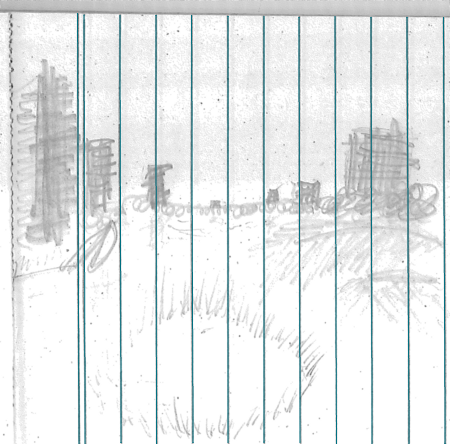
a sketch just faithful enough that I think of the open sky and the palms, and the flick of the fishermen’s nets when I see it. you, dear reader, will not be so lucky
On the plane, I met a man who said many things, more than one of them true, more than one of them false. He didn’t go to school with Bobby Jindal – but maybe he did think eating cornflakes was nearly as bad as learning Hindi. His mobile really is of astonishingly low entropy -311111111131- but it doesn’t follow that he’s as rich as he claims. He called his driver to come pick him up, on his cell, as the plane was taking off, but not every arrogant douche is a rich man. Is it true that rich religious minorities get to set up tax free trusts virtually as savings plans? Is it true foreign lawyers can’t make it through real estate law here? That only 10% of his workers are Tamil in origin? Who knows? His name was Antonio, too.
Narrative Mulch March 14, 2013
Posted by newsthatstaysnews in Uncategorized.add a comment
We arrived at the resort. Alonso and Sandy vanished. Sansón announced that he had given us all the gift of Sansón-songs, and we should be grateful. That there was an indian-style remix of the backstreet boys, and we had just seen it live and in concert.
“The stage is set.” He announced, ” The lights are on. Go ahead.”
I was told that we’d be singing next. I begged off that I could not sing. This would, as anyone who’s heard me try could attest, be ill described as a convenient fabrication. Still, my excuses were met with amused if politely indifferent rejection, and the threat of hearing more Sansón-songs. This would have been the honorable point to give in and sing something. I bickered a bit with my stranger, unable to agree on a song we both knew as I did not with at that moment recall a song at all. In the end, she sang a Disney song, and I was unable to recall the verses of that either
“The stage is set. The lights are on. Go ahead.”
I tried again to demure. Failing that, I sang ‘Ojala’, rather nervous about my notorious incapacity to hit notes. And, ironically, as I’ve heard that song perhaps two hundred times, I did fine with the notes, but sang with a rhythmless, emotionless drone that made nokia ringtones look like the rite of spring. As Reinhold Niebuhr would point out, a situation can only be ironic until you realize the irony. After that, it is either overcome, or it becomes tragic.
“The stage is set. The lights are on. Go ahead.”
We heard a nepalese song about the impossible injunction that a man cannot cry, however his heart should break.
“The stage is set. The lights are on. Go ahead.”
After more attempts to wriggle out, and with some assistance, we heard Dil Se Re, which I confess has somehow grown on me.
“The stage is set. The lights are on. Go ahead.”
Eugenio did not acquit himself well. He needed lyrics, so a smart phone was brought. He needed the right version, so a new one was found, and then another. He needed accompaniment so the beginning of the song was sung for him. He needed melodious music, so his own voice grated on him and then ceased.
“The stage is set. The lights are off. It’s time for dinner”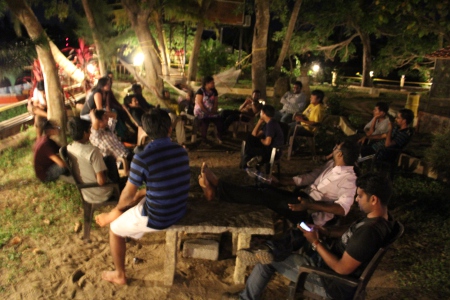
Building a good bonfire is not a skill that develops naturally in the tropics. It was striking that the meter-long pieces of wood were actually stood up against each other on end, as though to burn someone at the stake. This turns out to be a poor way to get a big fire going, so someone walked by with an aquafina bottle full of gasoline from time to time and poured it onto the fire. Eventually someone came by to suggest a game of musical chairs, but I was pretty
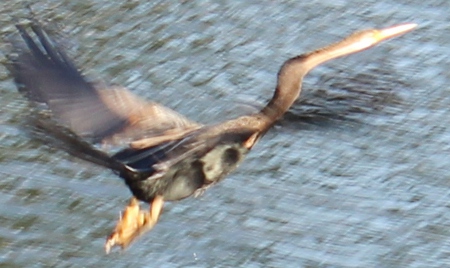
8 am found me paddling a canoe with a few guys even more clueless than I. We spun in circles a lot. I was a little frustrated, though it would have been hard to be too frustrated (see heron pictured below). I did not convince them to paddle more reasonably. Which is to say, I did not try. I broke fast with Sansón and a few others. They asked what my favorite Indian food was (rajasthani/gujarati thali, described in excessive detail somewhere below), and I asked theirs. This struck them as ridiculous, but produced solid if sadly theoretical answers.
I took to a hammock, thence to a boat, a bus, and the slavish ingestion of musical selections from Tamil movies. Once again, I thought that what passed for romantic courtship in times past really is called stalking now. I wondered how American movies would be worse if they didn’t have sex scenes, decided that “The Master” would not have been as good, gave up looking for a second example.
Eventually, to a 400 year old synagogue, grown decrepit before it had ever grown dignified, now tending to the few dozen local Jews not to have left for the Negev. Alonso made tracks for the comfort of a 5 star hotel. We for a maharajah’s portuguese palace turned maharajah’s dutch palace turned maharajah’s english palace turned archeological survey’s museum, which is about par for the course. I learned that I can’t read an illustrated Ramayana to save my life, that Sansón’s grandmother had managed to live into this decade without ever once wearing a blouse with her sari, that traditional keralan power had been held by men but inherited through women, and that in Kerala, timber is in ready enough supply to be used for construction. Somewhere not so far away, on a bright red string hung from the low clay roof tiles of the kitchen of a restaurant to the beautiful ochre beams of its iberian second-floor verandah, a crow swung back and forth like a child, while below the busload of us feasted.
Narrative Particleboard February 21, 2013
Posted by newsthatstaysnews in Uncategorized.add a comment
Round about three in the morning, Pedro Perez returned from the office, and traded me an inscrutable map for a mostly full container of potentially expired fruit jam of intentionally complex and empirically obscure flavor. A half an hour later, I was back at work, having missed my appointed rendezvous on account of no driver ever being able to find our B&B. Some time later, I was aware of being in the airport, having remembered to put tags on my backpack, having passed through security, set an alarm for the stated boarding time, and chosen a seat somewhere near the gate. Sometime after that, I woke up, and saw that boarding had begun. At the gate, I met Alonso and Sandy, the one concentrating his impressive and constant effluence of energy to handle the situation, the other chill. We boarded the JetAirways plane, predictably a turboprop, and
Somewhere around seven, we wandered off the plane. Alonso ordered up a big car like an Innova, bound for Lake Haven. He paid, we walked outside, and found a beat-up old jeep waiting for us.
“I got !@#*&ed,” he declared. “Where’s my Innova?”
Then we got in the Jeep, and
Somewhere around nine, the driver asked where we were going. He took the piece of paper we had with directions, looked a the cell phone we’d listed, and dialed another.
“What’s your name?” he asked me.
“Alonso”
I’ve long since learned to answer this question by borrowing a name from another in any circumstance where time is of essence and accuracy might be important. “Hamete” just doesn’t stick in anyone’s mind.
At this point, Alonso began to laugh, a nearly hysterical laugh colored by the effort of trying to contain a feral contempt. I recognized this laugh from a few days earlier when, in a state of exhaustion, I was presented with a hopelessly arcane outline for a solution to a simple problem, responded with a simple fix, and was told that thus removing the original problem entirely would be very helpful in resolving some technical aspects of the already envisioned impossibly elaborate solution. It is a self-righteous laughter, distant kin to the mirth which greets a friend when she pays a trivial but richly deserved price for a small act of idiocy, but blood brother to the laughter that greets an enemy when her deeper vices are called to account.
“What’s your name” Alonso cackled, “Like that’ll help. What’s your name?”
It can be easy to infantilize a person who struggles to express himself in your language. To fail to control this instinct is understandable, natural, and deeply unimpressive. At any rate, we drove on, asked for directions, and eventually found ourselves there, at which point

A boat and a bus ride later, I was skipping rocks from the yard of some old church, terribly ornate in a way I recognize from a two hundred year old chapel built by a wealthy family in among the vineyards south of Rancagua. (If you ever find yourself there, and are not too morally squeamish, I highly recommend the museum that an arms dealer and wanted international criminal built nearby). There was an interesting pulpit, perhaps 10 meters tall, and shaped like a lotus flower. And there was an icon with writing I’ve never seen, somewhat like cyrillic except that it had a character like a 4 and a p stuck together, and another like a two-button mouse.
We made our way back to the resort, where Alonso was highly bemused that I was “extreme” enough to eat lunch with my hands. I made my way to a hammock, with Chatwin, and talked to Sansón for a
I woke up around 2, and we hopped a boat, where we played a game variously described as “Ace” or “Ass”, and which seemed to consist variously of an elimination round rather like war, followed by a bit of card-counting which I consistently failed to reach. We stopped by a fish-fry, where we didn’t buy a refilled scotch bottle of distilled palm wine, perhaps because as Alonso informed us it was unhygenic.
“I know because a local told me it was unhygenic”
We stopped for tea and a power outage along the way, and then set back off through the darkness. Sansón led a spirited rendition of “Show Me The Meaning”, and I tried to explain to a near total stranger why one might date the same person more than once. In the choruses, the other men joined Sansón en masse. The stranger tried to explain to me the anxiety of always looking to trade up. I understood, but tried to find a way to politely observe that I’ve never dated anyone who could be “traded up from.” On the highest notes, sometimes the women supported Sansón, too. Sometimes a stranger forces you to give enough context to a story that it makes sense, and in the process you realize more about how the pieces fit together.
Sometimes no one forces enough context on a story for it to make sense.
Narrative Miter Box February 15, 2013
Posted by newsthatstaysnews in Uncategorized.1 comment so far
On Saturday morning, I’ll somehow make my way to consciousness, hop a cab to the airport, and board a flight for Kerala. Sometime later, Russ, Simon and I will meet the rest of QA at some resort in Allepey. Scheduled shenanigans will ensue, “boating in backwater canals” or somesuch. The next day, we’ll visit Fort Kochi, part ways with the QA crowd, and come evening I’ll make my way back to the airport, and a few hours later, one last cab will take me home.
 News That Stays News