“Didn’t you finish your field work last year?” June 1, 2017
Posted by stinawp in Uncategorized.trackback
Let’s face it, I’ve probably already had conversations with all of you about what I’m doing in Costa Rica this summer, but on the off-chance you’ve forgotten, or someone I don’t know is actually reading this, I’ll recap. I did finish my dissertation field work last year, and there was much rejoicing. After that, I applied for a Doctoral Dissertation Improvement Grant from the National Science Foundation, which provides money for what I’ve been calling a “cherry on top” project: It should make your dissertation even better, but it’s not part of your dissertation. In February, I found out that I was receiving the grant, and there was rejoicing, although it didn’t start immediately. (I had to send a couple of confused emails to my advisor because the bureaucratese was so dense, I couldn’t tell whether I was getting the grant or not.)
So, what am I doing with your taxpayer dollars? I’ve got two experiments going: a low-tech one and a high-tech one. The low-tech experiment involves putting hundreds of shelter-building caterpillars out in the field in different types of groups to see what the pros and cons of sharing a shelter with other caterpillars are. Are they better protected? Do they benefit from sharing the construction costs, or does the competition with their housemates hurt them? Right now, we’re* rearing bags and bags of tiny caterpillars in the lab until they’re big enough to put out on plants, which we’re doing every day now. Even though this is the labor-intensive, it’s still less work than what I was doing last year, which should give me time to work on my dissertation.
The high-tech experiment is pretty neat: we’re installing temperature and humidity sensors in shelters and on nearby leaves to see whether the shelters are providing any climate control for the caterpillars, and whether that has an effect on caterpillar survival. This is something people have been asking me about for years, but I never had the equipment to answer the question.
When a tree is all wired up, it looks like this:
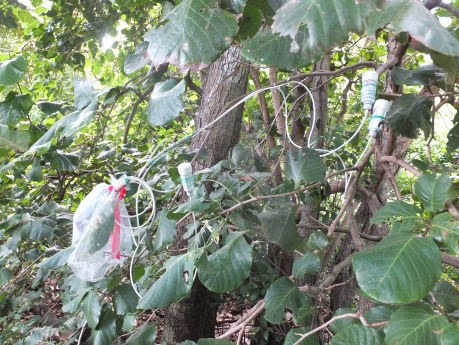
Each of the white tubes is a data logger that records the temperature and humidity every 15 minutes from a sensor. The bags around the leaves keep the caterpillars from being killed by anything except the environment. We check on the caterpillars each day, then move the equipment to a new shelter after three days.
Why does this matter? Well, since some shelter-building caterpillars can damage forests or crops and others are threatened, understanding shelters will make managing those species easier. And understanding how much shelters protect caterpillars from the environment is important for predicting how vulnerable these caterpillars are to global warming. If you want more details check out the project abstract at the NSF website: https://www.nsf.gov/awardsearch/showAward?AWD_ID=1701855&HistoricalAwards=false
* Yes, I have help. More about that later.
 News That Stays News
Comments»
No comments yet — be the first.