Pokhara March 21, 2013
Posted by newsthatstaysnews in Uncategorized.trackback
What a feeling to get off an airplane early one morning in a small city in the mountains where I’ve never been, turn confidently left, and start walking! I owe my dad here: hours looking at maps and photos of the mountains with him meant that everything I could see above the horizon felt comfortably familiar, even the huge clouds where the view of the Himalayas should have been. Small cities are open, wide, and every place in them distinctive, so you can’t get lost and don’t feel like anything will happen to you. In the morning, your steps are light, for if they go astray they can still be redeemed before nightfall.
Along the road, I stopped in a little hole-in-the-wall and replaced a white tourist at a low wooden bench. I looked at the woman who stood by a pot of boiling milk, age just beginning to show in her face, and knew that words were not going to get very far here. I pointed at the wrinkled man at the next table, and his tea. Mmm. The man got slightly stale puri and a side of a salty sambar with onions, a good deal less spiced than I’d accustomed to from the breakfast the Nepalis fix every morning in Chennai. Even as the last warmth of cooking ebbed from them, the puri were, after an hour and a half awake and moving, perfect.
Another kilometer along the road stood a cluster of knick-knack stands and a sign that says ‘Devi Falls’. Behind them were metal railings the color of an old British police box, and behind them, a river disappeared into a hole.
Across the road, beneath a gate marked ‘Gupteshwara” there’s a whole marketplace of gurkha daggers, solar-powered prayer-wheels and coca cola. In the back, I found what looked like a fancy public garden -all finished in that distinct matte grey of fresh concrete- from which a plug had been pulled, and which was swirling six or seven meters down into the ground. At the bottom, I crossed an archway into the heavy, warm air beneath the earth. With some obeisance to the knee spirits, I followed an old chinese-looking woman down the many concrete stairs to a small open chamber. She doffed her shoes and joined her daughter, walking with something like a cat-carrier towards a rusting metal cage. Within, a fire burned before a statue of the god.
I walked beside them and then down another flight of stairs to the left and ducked through a couple of low tunnels with walls of stone, mortar and chickenwire, up and down cement slopes with footholds fixed in convenient places, and emerged into fluorescent darkness. As I passed the familiar corkscrew energy saver lights, the darkness opened into a great cavern, its far wall rent and leaking sunlight. Down a set of metal steps welded at the wrong angle, along a stone slope, I found a place I could just sit, my recently-trimmed hair brushing the rock above me. Kids came and went before me, sometimes families. I sat, aware as I can only be in stillness of the sheer chaos within. Time passed, and the noise increased. Eventually, it sort of evened out, and I came to.
Dali said that to be perfectly rested, one should fall asleep in a chair, with a key in one’s hand held out over a ceramic plate. Just at the instant of falling asleep, the key drops from your slack hand, hits the plate, and awakens you. In a really good nap, I grow gradually less aware, and my thoughts less energetic, and then suddenly I am vividly aware of the tranquility within, and I get up. It’s cool and only slightly damp in that cave, and over the tourists one can hear the rustle of the deep waterfall just outside, and the light of the sun filtering in just enough to offset the harsh electric glare. It is a place I would like to remember, and would not mind coming back to, though I know I never will.
I climbed the road to the world peace pagoda with a tout. It was unpleasant. In a secluded place on a hillside, he told me his sister needed money for an operation tomorrow. I told him I didn’t believe him, but conceded that he’d shown me around, and gave him some money. I was irritated then, because with a touch more presence of mind I would have told him that I’d pay him for his services, but not under false pretenses. I was more irritated because I’d begun to suspect early on that he just wanted a commission for showing me to a hostel, but let him show me the shortcuts to the top anyway, hoping vainly that I might learn something from our conversation. As for the path splitting five ways a hundred meters from where he’d left me saying “just follow the road down from here, it doesn’t branch,” that was just funny.
I was a bit less amused when a little kid smiled and shyly greeted me, and asked me
“do you have a pen?”
and I said “yes,” and she said
“can you give it to me?”
and I said “no,” and she didn’t know what to do; after a while she asked for candy. For a kid, I hope it’s just something they laugh about when they think back on being little and having stupid backpackers all over the place. For a visitor, it’s kind of sad, because it means one more interaction is insincere, though perhaps if you follow the script to its conclusion, it leads to something genuine. All it does to me is to harden me, to where a kid asks me for money, grabs on to my leg with a triumphant expression and won’t let go, and I just keep walking. I have to say, the treatment of chickens in factory farms just doesn’t seem like one of the pressing moral issues in my life after that.
I sat down over a plate of Chow Mein at lunch, jotted a few things down, and thought about what I wanted to do with the second half of the day. The answer turned out to be “solitude.” I paid for my chow mein, and collected my change. Then, I looked at the woman, politely confirmed the price of the chow mein, and collected the rest of my change. She smiled mildly.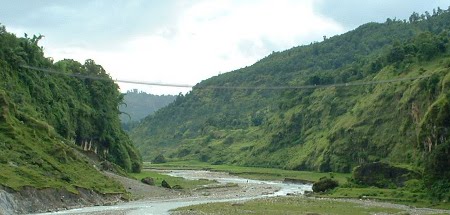
So I hopped on a city bus for Ghimire, got off at Chipledunga by accident, and made my way to the hanging bridge to Bhalam. I am unjustifiably nervous around things with more than four legs, turbulence in airplanes, people whose language I speak poorly, pretty women with intense stares that make me think I’ve missed something, ambiguous deadlines, and a few other odds and ends. But, I am flatly terrified of heights. The hanging bridge is steel, with stabilizing cables and fenced-in sides, and is basically the next safest thing after sitting on a park bench and eating peanuts. But, I shuffled slowly, steadily across, my hands on the railing despite the sharp wires used to tie the side-fencing. Next to the sign that says ‘Welcome to Balam, an area where open defecation is prohibited,” I sat to watch the river below, and saw with some shame a little kid come barreling down the bridge as fast as his legs would take him. “Okay,” I thought to myself abashedly, “I will not concede this to groundless fear: on the way back I will not hold on to anything.”
So, I walked back steadily, arms by my side but rising towards the railings every time my concentration wavered. Sometimes slower, sometimes looking straight down, but always advancing, chanting slowly. As it turns out, I have learned four things by heart in my life. One I can’t keep in order just now, one is for ritual use outside my community, one is an ancient Greek admonition, and one was especially inappropriate to the task. Nabokov rendered it memorably in English:
Do you recall the cry
Of gray Melchizedek as he prepared to die?
Man, he exclaimed, is born a slave; a slave
He must descend into the grave
And Death will hardly tell him why
He haunts the magic vale of tears,
Suffers and weeps, endures and disappears.
So I made do. Focusing all my conscious effort on trying to remember a few short snippets of Attic Greek in order, the river below and the gently swaying cables did not penetrate sufficiently into my awareness to incite terror. As I neared the far edge, the Greek phrases stuck fast enough in my memory to keep their order despite the pounding of my heartbeat, and I began to chant louder.
The bridge began a resonant swaying, and I knew someone must be walking up behind me. Not looking forward to the sensation of being passed, I walked faster. As I finally neared the edge of the gorge with some relief, a voice behind me asked
“Why are you surprised?”
“I’m not surprised!” I replied absurdly.
“Why so mysterious?”
the voice rejoined. I reached the cliff, and a few moments later stepped off the bridge onto solid ground. It was fair, I thought, for him to find me mysterious. After all, I was using twenty-three hundred year old magic to master my thoughts. This repetition of a mantra, is, in its own way, perhaps a bit like prayer. I turned to say this to him, but there was no one walking behind me.
I think I have a fair idea of what a person might reasonably accept as a minor miracle, were they inclined to. It turns out that I have an intellectual commitment that such experiences are so readily believable that a great many must be misinterpretations of chance accidents. Therefore, I am obliged to assert that the kid ten meters down the bridge watching the river, who did not keep walking in my direction, had been behind me until he spoke, but then turned and walked some distance away and stopped. This is, on the whole, a perfectly reasonable explanation. Besides, everyone knows God does not speak to one in a Nepali accent.
 News That Stays News
Comments»
No comments yet — be the first.