Narrative Sawdust March 14, 2013
Posted by newsthatstaysnews in Uncategorized.trackback
I started asking to Antonio about the way an idol worshipper thinks about the claim that an immanent and omnipotent god is also a living being inside a stone, needing food and water to survive. Antonio told me that an icon serves as a locus for prayer, which helps to focus attention. It’s usually hard for me to remember names, but I have a friend named Antonia, and a salsa instructor named Antonio, and so this one sticks. Besides, he was stubborn enough to hear me out, even if he did try to offer a ‘scientific’ justification in place of an explanation of how a true believer thinks about idols.
Eugenio showed up, and offered that true believers don’t often have time to just sit around and question what it means for God to be everywhere and here, or just what feeding a stone does, and that if this question was put to a true believer, they would effectively ignore it. But, I persisted, everyone surely thinks about such things occasionally?
We walked up to a two story wooden tower built out on a rickety wooden pier, and covered with weights. It began to tilt down towards us, and as it did, a vast net slowly emerged from the depths. I keep score differently when men build machines without iron. This was definitely cool. It also reminded me terribly of Age of Empires. So, that’s how you collect fish from a large, fixed wooden building.
Antonio asked me an interesting question: why the Christians always portrayed god in his moments of death, never in his resurrection. I objected that this wasn’t entirely true, but then I explained about original sin. I hazarded that no observer of human beings is liable to believe in our ready perfectibility, without much more time than we usually have to go about it (reincarnation), or a great deal of supernatural help. This made sense to him, but he asked me why God had to die before he would grant us grace, and lo! I had exhausted my theological reserves.
We walked onto the bus.
I asked, if they offer only an explanation of why continuity of belief is useful, how they thought people came to hold new beliefs. Antonio made the interesting claim that it is only in moments of desperation that we can achieve new faith, be it an extension or a contravention of the old. I’m not sure that prolonged contemplation cannot also achieve the same ends, but this is a luxury without equivalents in mere diamond or saffron. Through the subject of respecting the perhaps unconsidered beliefs of others, we came upon the matter of persuasion. Antonio argued that one can simply point out to people the examples which contradict their beliefs, a rather Meno view of the transmission of achieved knowledge. I did not believe this, but in time I was forced to confront the classical claim that to understand the good life is to desire it. If I really do believe that, then I should try to talk people into and out of things far more often than I do. If I do not believe it, I should accept that the foundations of the idea of virtue may be rather shaky in its absence.
We arrived at the boundway, such as it is, and I stepped off, shaking Sansón’s hand as I did. And from there, until I finally found and paid a taxi to take me to the airport, I walked. Past a water main with fishermen standing on it, casting their nets into the river. Past and through a bakery, where I bough almonds dried and salted in California. To the poorly-gated lot across from the Kerala Institute of Fine Arts, where among families, I caught my sunset on the arabian sea, to bookend the sunrise in pondicherry. To the state bus stand, where five men yelled offers to help me, in english and in parallel. To the auto stand nearby, where they swore there were no taxis around.
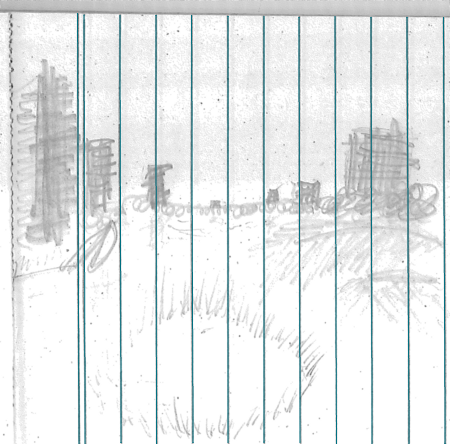
a sketch just faithful enough that I think of the open sky and the palms, and the flick of the fishermen’s nets when I see it. you, dear reader, will not be so lucky
On the plane, I met a man who said many things, more than one of them true, more than one of them false. He didn’t go to school with Bobby Jindal – but maybe he did think eating cornflakes was nearly as bad as learning Hindi. His mobile really is of astonishingly low entropy -311111111131- but it doesn’t follow that he’s as rich as he claims. He called his driver to come pick him up, on his cell, as the plane was taking off, but not every arrogant douche is a rich man. Is it true that rich religious minorities get to set up tax free trusts virtually as savings plans? Is it true foreign lawyers can’t make it through real estate law here? That only 10% of his workers are Tamil in origin? Who knows? His name was Antonio, too.
 News That Stays News
Comments»
No comments yet — be the first.