Madras on Rainy Days* February 4, 2013
Posted by newsthatstaysnews in Uncategorized.trackback
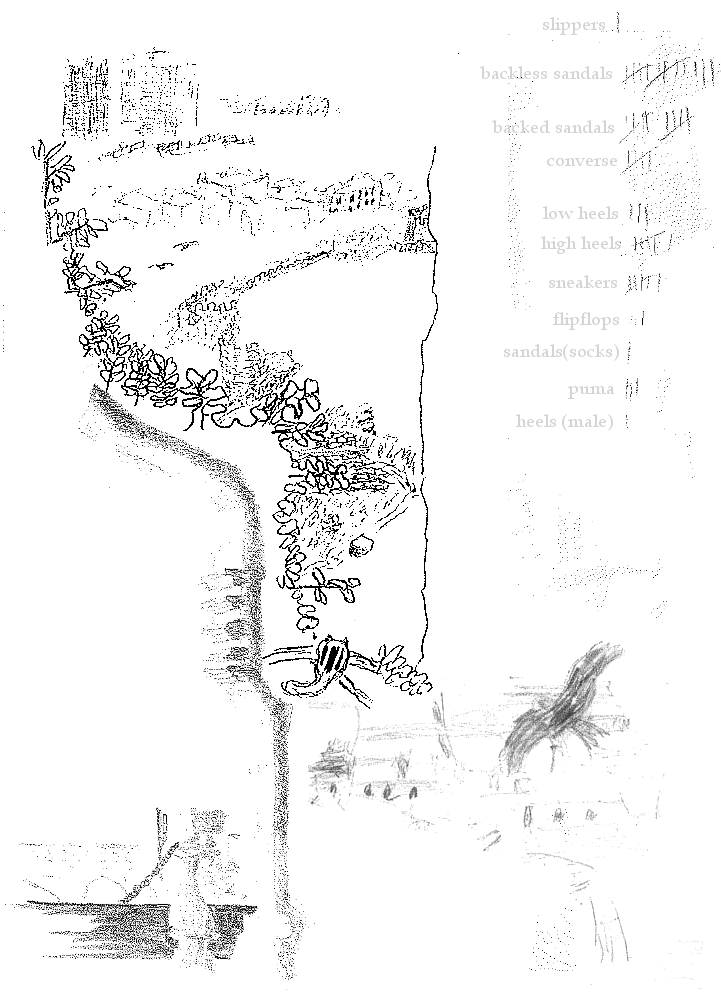
(click for full-size)
Sleep ends. I ask for Nayamapallam, am laughed at, dropped off the bus in the middle of nowhere. Perhaps, for all I know, this is a kindness. Two hundred rupees to an auto driver turns out to buy advice on which bus to take to the Mehdipatnam station (19), and which bus to connect to (142). Seven in the morning, the station, asking for bus 142, alleged to end at Golconda Fort. Bouncing back and forth in pursuit of a bus whose existence I will never confirm. A woman walks by, like they would say in the stories, who seems to be becoming a part of the street. Her makeshift clothes are almost indistinguishable from the refuse on the roadside. She drinks water out of a plastic garbage bag, like a soiled, mottled wineskin. She is hunched, wrinkled, features rougher than the asphalt she walks over. I am ashamed that I have given a smattering of coins here and there to people who claimed to be in need, but this woman never asks for money. Perhaps I should give her money regardless. Time will not bring understanding, here.
An hour later, it occurs to me to drink some ‘Balam’ tea. Tea north of Tamil Nadu has too much sugar, too much nutmeg. To a philistine, this one tastes like a pumpkin pie. A few minutes later, I think to ask for Golconda Fort. Momentarily, I board the 65g, and in a quarter of an hour, emerge by the fort, to find a breakfast of deflated puris and something like sambar near at hand. A few minutes wandering brings a stationery store, and a pencil like the teacher in Hampi had wanted. Mehlville’s distracted man always rambles to water; perhaps when I am not distracted, I wind up on a summit just as inexorably. This one has a path around the side of the fort, hot and strewn with plastic litter, but solitary. Machine guns chatter from an army base below, their dialogue first unnervingly alien, then merely incomprehensible, finally part of the landscape. In a bush, a chipmunk stirs. I sit down on a stone, try to draw him before he disappears. I get something, and he’s gone, but his front-porch remains, and I try to draw it, too. Like an unruly horse, the pen makes its own choices, and I try to live with them. People come, say something, go. They repeat, the guns repeat, slowly my meager landscape grows.
I’m told drawing teaches you to see. Maybe drawing teachers teach you to see – I don’t know. I see this bush, this wall, these far-off apartment towers, but my pen has catarcts. Eventually I stand up, walk back east, take in the eagles flight, disconcertingly dozens of meters below me. Majestic creatures. Where they soar, the pigeons flee to ground. More people pass beneath my archway, laughing, hugging, carrying on. Actually, every time an eagle even gets close, the pigeons land safely. These eagles must be getting hungry, at this rate. I think about drawing them. Perhaps the teacher was right, so I fish for my pencil, find it unsharpened, try to give it a point with a rough stone, and draw what I see. Turns out an uneven rock will only resharpen a pencil that has already known a point. I try anyway, moving back and forth to catch their majesty with my eyes, and perhaps wrestle it to the page
One of them swoops up above another and tries to pounce with its talons. Man, these guys are not much good hunting. I scribble something. The pencil resists, then lunges when I’m least expecting it. Dark lines appear, and I try to hide them. Warm sweat sits comfortably in my shirt. It’s time to make my way back down, buy a pencil sharpener, board the 66g. We pass through muslim neighborhoods, women with head scarves everywhere, burkas common if not typical. We return to Mehdipatnam. I ask an old man with bright red hair if I should get off here for Char Minar. I understand that it’s the end of the line. I sit, I wonder why it is only here that I’ve seen men cover age with bright red hair. Wonder, like the dark red color grown popular among American women, the mere act of deciding to die one’s hair conveys some vitality without needing to resort to subtlety.
Neighborhoods sweep by. A palace, it seems, for the local Congress party. Stores of every description. Restaurants, homes. Streets, avenues, alleyways. Time passes, the man gets off, I remain. Eventually we cross a river, pass what seems likely to be the Salar Jung museum, a comforting omen for my half-imagined day trip. Up the hill, writing in arabic again, banners for muslim parties, women everywhere more covered. Eventually a station. I’ve seen no tall four-masted building adrift in a rotunda, but the sun tells me that it’s behind me, and that I should change my shirt. I ignore both suggestions, find the legendary Pista House, self-proclaimed largest Haleem seller in the world. I am told lunch has yet to begin, buy a pizza crust, strike out for the Char Minar. The pizza crust is sweet, but the road is warm, the traffic light, the building tall. I make my way up an interminable spiral staircase, past a still-young woman who’s nevertheless surrendered to gravity, reach the lower gallery. Around me, a city. I walk back. The broad streets, tin roofs, the press of largely black-clad pedestrians, the riot of shop signs and satellite dishes, the preponderance of black dress on the streets all remind me of the view from above the Damascus Gate. It’s hot, so I sit down in the shade next to some middle-aged woman, offer her of my water and bread, am offered solitude in exchange. People walk back and forth. I sit, low, look at their shoes, start a tally to see what they’re wearing, my silly linear concept of modesty forever surprised to find women in burkas wearing shiny heels, even low ones. And why not? I sketch some of the archway to pass the time as shoes pass me. Children arrive, curious to see my drawing, and leave indifferent. Eventually I rise, walk to the exit, find it’s been jammed with pedestrians and isn’t moving. Laugh, because it is both surprising and expected. Sit, wait until another exit is opened and the queue to recede, recede with it.
I return to the Pista House, wait 20 minutes, learn that service will be another 20 at least, actual arrival of food unknown, perhaps unknowable. I come to terms with leaving Hyderabad without knowing what anything Hyderabadi is supposed to taste like, take off. On the way to Salar Jung, I buy a square naan. It’s sweet.
The Salar Jung is a millionaire’s collection of fancy trinkets. I hold out hope for a long time. I see the ‘veiled Rebecca’. Very skillful illusionistic marble textile, little else. Make my way to the bronzes in disappointment. Mistake; they turn out to be copied western bronzes. Around them, more anonymous copies of western marble masterpieces. Laocoon and his sons struggle to raise their hands high, so the teacher will call on them. Universally, the textile work is fantastic, the humanity absent. One, labeled only ‘Night & Day. Florence’, lets the copyists awe show through the difficulty of carving stone without genius. A piece of gratuitously sugary street bread and a one-way ticket to Aurangabad says the original’s a Michelangelo. Both remain in store for me. I thread my way back. A real Canaletto fairly beams from its place in a european painting wing. Out of nowhere, a wooden carving: Mephistopheles on one side, Margaritte on the other, so skillfully executed that as I look into the mirror before it, I cannot shake the feeling that is the glass and not the statue that is engaged in some subtle trickery. Perhaps I should linger, but the rest of the museum awaits. And then it doesn’t. There’s been a wonderful japanese scarf, ‘the thousand cranes’, clouds, patches of sunlight on the lake, trees and cranes all having somehow become indistinguishable, even as my eyes promised that every individual portion was visually interpretable. I resolve not to buy trinkets, for I have now seen the master of all trinket buyers, his jurisdiction global and his means all but limitless, and half a century later his home is become a hall of glorified knick-knacks. There is a wing of miniatures. I try, but I do not understand miniatures. I turn to go.
On the street, a man holds a door frame, with a door in it, talking to another man. By the railing are more doors. I cannot shake the certainty that this door salesman will at last open his door, and his client walk through it. I am not so foolish as to expect him to disappear when he does. Perish the thought. But, somehow my reasonable expectations of the world have had injury done to them all the same. Now, a bridge. A hospital. Alleyways strewn with trash. A small storefront BJP office, seemingly part of the community. An autorickshaw driver who has no clue where he’s going, then accidentally takes me past the place. He as bewildered as I when I tell him to stop, perhaps just as resentful. But my auto payment philosophy is strictly consequentialist. From here, another auto reaches a van which reaches a bus which reaches the outskirts of hyderabad’s HiTech city. Plate glass everywhere, bright colors, bright lights, photographs of very pale models. In time, the bus to Aurangabad comes. Sleep follows, eventually.
* I read a book with this title, hoping it would tell me about Chennai. Whole thing was set in Hyderabad, to my consternation.
 News That Stays News

Comments»
No comments yet — be the first.